

If you’ve ever spent any amount of time on the conflicting being that is the internet, then you’ll know the interwebs can’t get enough of “what-if” questions. This isn’t limited to just fantasy Hollywood couples either (and jamming those couplings down people’s throats), as even the car community loves contemplating such questions. Especially in the case of cars that have held stubbornly to a single idea, principle, value, cylinder count, engine size, or engine placement (or cars that have been gone for a very long time). Some people ask “what would a modern Lancia Delta S4 look like?” Or, until recently, “what would a mid-engine Corvette be like?” These kinds of “what-if” questions are common among the curious in the car scene and can lead to some incredible discoveries for those who take action on those queries…
Another fairly common question is whether or not the Viper will get or ever has had a V8 engine. For the former part of that question, it most likely asks whether or not Dodge will put the infamous Hellcat V8 in the Viper chassis. Unfortunately, the Hellcat V8 engine is too wide (it wouldn’t fit between the frame rails), so that avenue is a dead end. What about the latter half of that sentence though? Has the Viper ever had a V8 engine? Outside of the very first Viper prototype (VM-01), it seems there has been…
The Context:
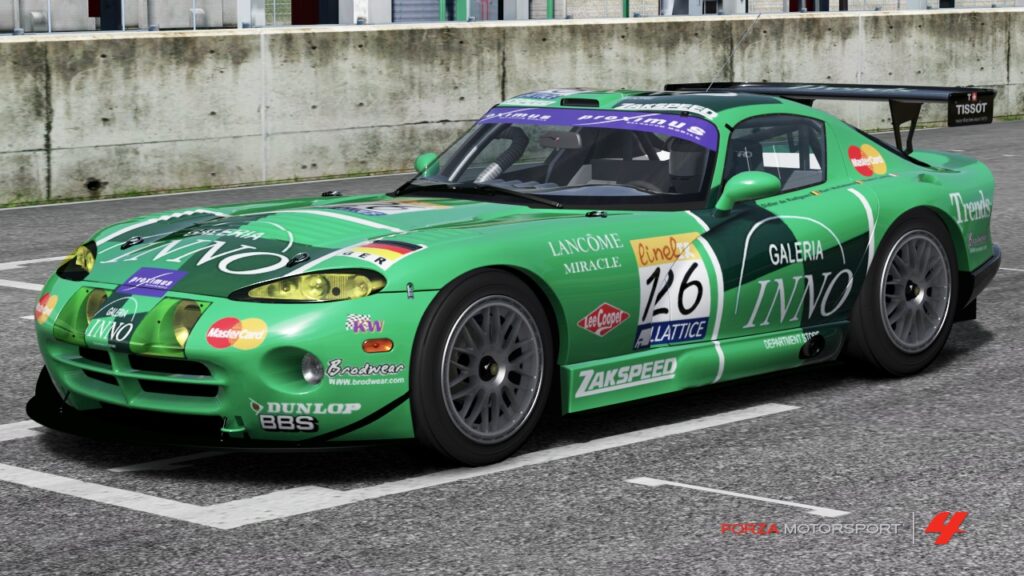
Let’s start at the first event that put this question in my mind (and then was put on the back burner for many years). Back when I was a wee lad, I played Forza Motorsport 4 until my fingers lost strength. I was still a Viper-Nut even then so you can imagine that I had a crap-ton of ’em in my garage (even though I was better at being diverse in my car collection back then). One of the Vipers I had was this green Gen II GTS-R that I nearly didn’t buy because I already had the red one. I figured it couldn’t hurt to buy another (“just because”) and used my immense bankroll to buy another GTS-R.
I got it in my garage and, naturally, wanted to try it out. I went to the Top Gear test track, launched the car, and heard a distinctly non-Viper engine note bellow out of the side exhausts. I’ll forever maintain that the Viper easily has one of the most distinct engine notes in the entire galaxy, so it wasn’t hard to tell that something was very off with the sound of this GTS-R. I really didn’t pay much attention to the stats bar in the garage menu back then, but I did notice that this GTS-R had an engine that was significantly smaller than the one in the red GTS-R, but I never put too much thought into what that meant.
A little bit later (when I was about 14 or 15), I was browsing YouTube looking for Viper videos as I usually did. On this particular day, I saw a strange-looking thumbnail and title out of the corner of my eye: “Zakspeed Viper Onboard Nurburgring”. Being the curious person I am, I decided to give the video a watch.
What I would hear was a Viper that sounded NOTHING like any other Viper I had heard (except for the green one in FM4). I heard many other Vipers at that point in my life –including some GTS-Rs– so I knew for a fact that there was something very different about this car. I don’t recall connecting the dots back then that the two were likely one-in-the-same, but it was obvious something weird was going on.
A few years pass from that point (I’m probably 16 by then), and I come across this article: http://www.dailysportscar.com/2017/01/03/2016-goodbyes-the-viper-part-3-the-zakspeed-saga.html
In that article (near the bottom), it details something that was prickling in the back of my mind ever since FM4. Something that was there but I never really pulled out of my brain until that moment. It solidified a thought I’d been having about why the green GTS-R I drove (and watched) sounded so different from any other GTS-R I had heard up until that point.
The Engine:

To paraphrase that article: There were regulation changes during a Nurburgring race in Germany and a team running a few Vipers –Zakspeed– were basically written out of the rules. Because of the Viper’s dominance, new rules stated that the maximum engine size was now just 6.2 liters, obviously disqualifying Vipers because of their massive 8.0-liter planet starters.
… or did it disqualify the Vipers? Sure, Zakspeed needed a cunning way to make the engine smaller, and reducing that much size from a big engine is a Herculean task (made worse by the fact that the rules stated you had to use the original engine block), but where there’s a will, there’s a way.
Being the sneaky little gits that they were, they realized that the rules stated you had to use the original engine block, but said nothing about needing to use all of it, and fortunately for them, Caldwell Development had just the solution they needed: Make the front two cylinders ineffective. They achieved this by removing the rods and pistons from the front two cylinders, plugged the lifter bores, and removed the rocker arms as well as the valves and springs. Not only that, but the crank and camshaft also had to be changed! For both, Caldwell elected to change the crank and camshaft to fit the new V8 configuration. However, they added a –useless– shaft onto both that ran the remaining length of the block (where the front two cylinders should’ve been). In short, they made a V8 engine within the V10 block.
These alterations brought the engine down to 6.2 liters and resulted in a power loss. Though to a still mighty 620 horsepower at a claimed 6900 RPM. Still, that’s one helluva loophole! Utilizing the stock block but reducing the number of powered cylinders is one of those “that’s so clever I wish I thought of it” stories that remind you just how crazy the human race can be sometimes.
So now I learned the story behind the car in that YouTube video and in FM4. “That’s it” I thought, figuring I’d make a small, fairly insignificant article some time down the line and that would be that. Well, about a year ago, I am once again looking at Viper stuff on YouTube and I come across another strange-looking video. I click the thumbnail, watch the video, and hear a sound that brings me back to my youth. It’s a sound I was familiar with but couldn’t believe was being played into my earholes. It was the sound of ANOTHER V8 Viper! There was no mistaking that this car was different either, because this car was red with a fairly unique livery. “Holy crap” I thought, “OK, now THIS is a story worth writing about”.
Then I procrastinated on the article for a few months (oops). Finally, in March of last year (2020 for anyone reading this article years into the future), I went back to re-watch the video and found out something even more incredible…
There isn’t just one V8 Viper in existence. There. Are. Three. In the initial draft of this article, I actually thought there were six, but as it turns out the three just underwent frequent livery changes in the 3 short years they ran. In any case, it is now finally time to talk about the three cars I encountered on my search (HUGE credit to Shawn Romig and his new website Viper Racing History.com for being the definitive source on this subject. If not for a last-minute check on his website I wouldn’t have known that there were only three V8 Vipers, not six like I originally thought). Without further ado, let’s talk about the three unicorn Viper racecars…
(Side note: There is a lot of information about these cars in Shawn’s index, and out of respect for the countless hours and effort he’s put into it, I will leave some information out –though nothing important– so you can have the joy of discovering more things about these cars on your own. If you want to know more, then I urge you to head over to his index and read to your heart’s content! Now on with the Vipers).
Viper GTS-R – Chassis Code C15
Arguably the most known and storied of the three, C15 is the oldest car of the bunch. According to Viper Racing History.com, it was originally produced in 1999, with its first owner shortly thereafter being the famous Zakspeed Racing team in Germany (yep, the same Zakspeed that is running a Viper GT3-R in European races right now). Despite what you might think, these ORECA GTS-Rs didn’t originally come with a 6.2 liter V8 (nor were they an option). In fact, Zakspeed originally ran C15 in its intended 8.0 liter V10 guise for some years. It wasn’t until that dreaded regulation change in 2004 where the Zakspeed team would run into trouble. As mentioned above though, Caldwell Development came to the rescue and made the wild V8-within-a-V10-block engine we’ve been talking about.
Unfortunately though, all good things must come to an end, and by the end of C15’s racing life, it suffered an accident at the end of its career and hasn’t raced since.
Mind you, the car isn’t rotting away in a barn somewhere. In fact, a company called Heurich Classics –at the request of the person who owned it– converted the car for road use and kept the unique V8/10 engine! Of course, converting a race car for road use does mean removing things that are allowed on race cars that aren’t allowed on the street. Some of the things they changed included removing the diffuser, adding a handbrake, re-adding the passenger seat, changing the wing, and a few other things that you can find here in this article. This ultimately makes it –in my opinion– more like a heavily modified Gen 2 Viper than a purpose-built racecar. With that said, Heurich did a good job not neutering the car too much. While it’s hard to ignore how “tame” this car looks when compared to the non-street-legal version, it’s better than the car not existing at all! There’s even a video where the car made an appearance (and seemingly the last one it made).
Back on point though: While it sucks the ORECA GTS-Rs got neutered like this, the rule change did have one positive effect though: It gave us a proper idea as to what a true-blooded, Mopar V8 Viper would potentially sound like if Dodge decided against doing the V10 (which, if you read this article, you know that it was a vaguely considered possibility). Without that rule change we might not have ever heard such an awesome sounding V8 noise come out of a Viper, so hey: Silver Lining.
Viper GTS-R – Chassis Code C36
The second car in the V8 Viper trilogy is this one: Chassis No. C36. Manufactured just one year after C15, Zakspeed also owned this car and gave it the same make-shift V8 treatment as C15. However, unlike C15, C36 was the recipient of another result of Zakspeed’s madness…
Thanks to… shall we say, “displeasure” among German manufacturers regarding the GTS-R’s dominance, a new rule was put in place specifically for the Vipers in an attempt to hinder them. This new rule stated that the Vipers could only have a 90-liter fuel tank (as compared to the standard 120 liters one that other cars were allowed to run). Obviously not having any of ADAC’s bull (ADAC was the organizer for the races Zakspeed ran these Vipers at), they came up with an ingenious solution: Make the whole rear section of the car –everything from the cabin backward– rotate on a massive hinge. You know how the Ford RS200 has almost the entirety of the rear bodywork on a hinge? Yeah, Zakspeed applied that idea to C36. This, combined with what they called a “quick-change fuel tank”, was their solution for the clearly discriminatory new rules.
Here’s how the whole system worked: When the GTS-R needed fuel, the driver would pull into the pits, then the pit crew would open the rear bodywork and lift the empty fuel tank via two handles on the sides. Once the empty fuel tank was out of the car and out of the way, they would replace it with a fuel tank that was already full, and send the GTS-R back out to do battle.
“How did this ever pass inspection?” I’m not totally sure, but it did! Initially anyway. Zakspeed could do this entire process in just 20 seconds. Apparently, it would’ve taken them two seconds longer if they had a full replacement tank instead (as reported by Dailysportscar).
However, once the organizers saw the true effectiveness of this system, they gave the GTS-R two 5 lap (or 45 minute) penalties during the race, ruining the chances of the GTS-R finishing well. Not long after, they banned the system outright.
Outside of the… “fuel woes” C36 suffered, there’s another interesting thing about this car. Remember how I said there was a strange green Viper GTS-R in Forza Motorsport 4? As it turns out, C36 was the very car that ran this livery! That means C36 was the Viper I bought and drove in FM4 (and the GTS-R chassis that made an appearance in the aforementioned game)! How cool is that!? We now have a definitive answer as to what that green GTS-R was in FM4 (a game from two console generations ago!)
Viper GTS-R – Chassis Code C52
By far the youngest of the trio, C52 is the last ORECA GTS-R to receive the Caldwell 6.2 liter V8/10 engine. While it’s easily the newest of the three, it was also raced around the same time as the other two cars as well as at the same events. Like C15, C56 was also backed by Dodge Europe (strange how C36 wasn’t given such –perhaps only moral– support). When it was backed by Dodge Europe, it got a similar (but different) red with dual-white racing stripe livery as C15 (think of the American Viper GTS-R livery and you’ve pretty much got it). Sadly, this V8/10 GTS-R suffered from a bit more bad luck than its siblings during the races it entered. Eventually getting as bad as never finishing a single race in the VLN or ADAC events it entered (despite running at the front of the pack when it was working).
However, this story does end on a high note. After the car stopped racing, a museum in Switzerland (of all places) bought the car and still owns it to this day. Better still, this museum is a dedicated Viper museum! Not only do they have various road-going Vipers, but they also have a wonderful array of ORECA GTS-Rs! If you’re a Viper fan, have a passport, and have the money, then you definitely need to go see this museum in person (as I intend to)! The cars don’t just sit there to wither away either, as the museum makes sure the cars see some action at the track. Now that’s what I call “taking care of the exhibits”!
Video Evidence
By this stage, I’m sure some of you are thinking “cool, but where are the videos of these cars that you mentioned earlier?” Fear not, for they are embedded below. We’re also going to go through each video and clear up which of these cars appeared throughout (as well as explain the liveries a little bit).
In this video, C15 makes an appearance (though only once, and right at the beginning). It was a little bit hard to see the livery thanks to the quality of the video, but in one frame I could just make out the racing number as “88”. So I searched for “88” in my new favorite Viper index ( Viper Racing History.com) and discovered that C15 (as said earlier) was the car that ran this livery. The aforementioned site also tells us that the change in livery (from the previous red Dodge Europe livery with racing number 66) was because Zakspeed turned this car into their customer car for amateur racers. It also made an appearance in this video and this article.
C52 (the youngest GTS-R featured here) makes an appearance in this video! And in both of its Dodge Europe liveries no less! Actually, three liveries show up, but at the very moment of writing this paragraph I have no idea what the story is behind that design so I’ll get back to you on that when I read about it.
For now, let’s stick with the two red cars. In the second video (embedded above) the first livery that shows up is (from what I can gather) the one the car debuted with. That version of the Dodge Europe livery has a noticeable lack of dual-white racing stripes, but it does have some small white accents on the front bumper and black rocker panels, so it’s not a completely solid-red car. More decals were added as time went on, but soon the decals and liveries would receive a bit of an overhaul…
This is where the second red Viper we see in the video comes in. It’s still red, and it is still backed by Dodge Europe, but now it has far more white accents around the body. For me, the most striking white accent added to this car is the sort of “Lucha Libre” mask design around the headlights. In terms of best Viper liveries of all time, this design should easily be in the same conversation as the American GTS-R red with dual-white racing stripes livery, and the white with red and blue accents livery from ORECA. It’s just that iconic to me.
Alright, with those cars out of the way, I can talk to you guys about the white car near the end (as I’ve finally read up on what info there was regarding this livery). So, from the top: After we see the red cars, near the end, we have a complete change in the color palette but a similar decal package to the second Dodge Europe GTS-R. Thing is, this car was actually C15! For whatever reason, Zakspeed decided to use their updated Dodge Europe Red decals, but make them black and white, then put them on a car that didn’t originally run that decal package in the first place. Perhaps they wanted more cohesion with their liveries? In any case, this livery was short-lived, as the car apparently suffered an accident near the end of its career and hasn’t raced since. If you want to see more of this livery, then it also makes an appearance in this video, this article, and this article.
Remember that accident I mentioned the C15 suffered at the end of this career? More likely than not, this was the livery the GTS-R had right before it wouldn’t race again.
And last but in NO WAY least, we have this glorious video showing some onboard footage of the solid-green C36 car utterly obliterating the Nurburgring and everything in its path. This was the video that I mention at the beginning of this article, and it’s the video that solidified in my mind that there was something bizarre afoot in Viperdom. If there are two things I need to thank for tipping me off about these cars, it’s Forza Motorsport 4 and this video.
If I remember correctly, there’s even a part in the video where the driver hits redline and the whole car shakes violently. Not tearing itself apart or breaking, but just shaking vigorously from bouncing off the rev-limiter. I think it happens just a bit before the Karussell (so five-ish minutes into the video).
So, do –Mopar– V8 Vipers exist? As a matter of fact, they do! And it’s all thanks to some wacky regulations that tried to hinder the success of the GTS-Rs. What a truly bewildering world we live in, huh?
In any case, I hope you learned something new and found this article informative! Tell me what you think of these cars in the comments below! As always, I’ll see you all in the next Viper Week article.
Credits:
Viper Racing History.com: Without this new and astonishing resource I wouldn’t have been able to make the corrections I needed to make, nor would I have been able to tell as comprehensive a story. Go. Check. This. Site. Out! There’s so much to learn about Viper racing history and Shawn does a brilliant job laying it all out! He’s not even done either, so more information will be coming down the line! Keep up the good work and godspeed to you sir.
Viper Motorsports Tumblr: Another hidden gem you all should check out in your spare time. There’s a metric boat-load of pictures and many of them revolve around Vipers we talked about here! Wouldn’t have been able to add photos for C15 or C36 without this tumblr page so thanks a ton for having these photos in your extensive archive!
This Dailysportscar Article: Wouldn’t have gotten the hunger for more knowledge on these cars without this article giving me the info I needed to begin my search in earnest.
This DriveViper post (also by Shawn): Additional information and confirmation that C36 did show up in Forza Motorsport 4.
This Wikimedia file: For providing me with the perfect feature image for this article!

This ViperAlley Post: Additional information on the V8/10 engine.
This Racing-Sports Cars page: Before Shawn had his archive up, I used this site to find chassis codes for the cars I was seeing in the videos. While Shawn’s archive is far more comprehensive for these cars, this site is where I first learned about chassis codes C52 and C36.
