

How disappointed were some of you when you heard that FH5 would be set in Mexico instead of Japan? Fans of the open-world driving series have been clamoring for Japan incessantly and it seems Playground games have once again denied fans their request for “driving nirvana”. If I’m being honest, I was never one of those asking for Japan. It would make for an awesome map sure (especially with a well-done city) but I feel like people kind of overhyped it as a driving mecca. There are other places in the world with great driving roads and car culture people.
This overblown enthusiasm is why I found it very funny when Playground Games announced that Forza Horizon 5 would not take place in Japan, but rather Mexico. I mean, you really couldn’t have gotten further away if you tried, Haha. That aside, Mexico is an interesting and -for me- unexpected locale with a lot of history and, as per the title, some oddball Dodges. As such, let’s smoothly transition into the top 5 unusual Dodges I’d like to see in Forza Horizon 5!
5: The Dodge Neon

“WHAT!? When did Dodge make another Neon?” Well… they sort of… didn’t. Some of you will already know, but this car is actually just a rebadged and renamed FIAT Tipo. For whatever reason, Dodge got a hold of a Tipo and thought it would make a great replacement for the rebadged Hyundais they were also sold exclusively in Mexico, and thus a new Dodge Neon was born.
Given that it’s a FIAT, no one will be shocked when I say that it isn’t especially powerful. The normal engine (the 1.4 liter “FIRE” four-cylinder) only makes 95 horsepower and 94 lb-ft of torque, and the second engine available (the 1.6 liter E-TorQ four-cylinder) makes a similarly measly 110 horsepower and 112 lb-ft of torque. Yikes. Also, don’t confuse the E-TorQ with eTorque, as the latter is a completely different powertrain setup.
In any case, this means the third-gen Neon is less powerful than the first-gen –homegrown– Neon from the 90s. In fact, the potency of the first-gen Neon’s engines was actually one of its best attributes. Beating all but one competitor (the Civic) in horsepower, but easily beating all for torque. Relative to the class, the 2.0 SOHC and 2.0 DOHC were powerhouses (making 132 horsepower and 150 horsepower respectively, as well as 129 lb-ft of torque and 133 lb-ft of torque respectively). Clearly, the third-gen Neon is a downgrade in this regard.
What it lacks in horsepower though it does make up for with good handling. The praise isn’t as high as it was for the original Neon, but no review I’ve seen has criticized the car for not cornering well.
Where this Neon excels though is in the looks department. I might be in the minority when I say I liked the way the original Neon looked, but so be it. That car had a cute and friendly appearance, like a puppy happy to see its human! Even still, I do think this Neon is an improvement visually. The Tipo’s design looks like it was meant to have the Dodge Crosshair grille, and overall it has the appearance of a far more grown-up and mature Neon. Perhaps not as charismatic, but the second-gen Neon (pre-Daimler) wasn’t quite as charming as the first-gen either. The slightly frowning face it has would really lend itself well to an SRT upgrade as well.
Ultimately, it isn’t the kind of car you’d normally expect to see in the Forza franchise (primarily because of how normal and boring it is) but I’d like to see it in the game as a driveable vehicle anyway because it’s a handsome little sedan (in my opinion) that would give some competition to some of the other slow offerings in the game. With that said, even I know this vehicle is much more likely to be relegated to a simple AI vehicle (which would be a crying shame).
4: The Dodge Ramcharger

Ah, the old Ramcharger, Dodge’s Ford Bronco competitor that sadly bit the dust in 1993 (1996 for Mexico). Many a rumor over the last decade have swirled around its possible resurgence, but we can see that all of those were just that: Rumors. Indeed, it’s sad that Dodge’s rugged, off-road-oriented Blazer and Bronco competitor has yet to come back (assuming it ever will), but it did –thankfully– receive one last chance of life after 1993, though not in the way you’d expect…
The image you saw at the top wasn’t some masterfully executed photoshop image of a first-gen Dodge Durango. What you saw was a real, authentic, third-generation Dodge Ramcharger! Only sold in the Mexican market from 1999 to 2001, this vehicle is both exactly what you think it is and nothing like you think it is. Yes, you have what is unquestionably a BR-series RAM 1500 face, but that Durango-like bodywork –from what I can work out– is actually the result of modifying a quad-cab BR RAM 1500 (and not the result of a modified first-gen Dodge Durango, which only came out a year before). In essence, they shortened a quad-cab (both in body and chassis), grafted a Durango-style roof on, used the tailgate from a Dodge Caravan, modified the taillights, and called it a day after putting it up for sale in the Mexican auto-market. The reason why Chrysler went through all this trouble is that, unlike in America at the time, two-door SUVs like this were still popular just down south, and with the second-gen RamCharger axed in 1996 (with no replacement in sight), the Mexican Dodge executives begged and pleaded with the main Dodge boffins to do allow them the chance to rectify the issue. So they said “fine, but you’ve only got three million dollars to get it done” and so they set to work. Now to put things into perspective, normal car development costs are regularly 20 times that amount. Worse still, that’s me being exceedingly conservative too, as that’s assuming there are some carry-over parts from the previous model. If we’re talking all new everything, then billion-dollar development costs are awfully common in the automotive industry. As you can see, the Mexican Dodge boffins and engineers were effectively told to make a new model using whatever leftover table scraps and bottle caps they could find.
Let’s move onto the powertrain though. As mentioned earlier, the engineers who came up with this rolling photoshop experiment were forced to raid the Chrysler Corp parts bin in order to stay within their budget. As a result, the RamCharger has the familiar 5.2 liter and 5.9 liter V8s which can both be found in the first-gen Durango as well as the BR-series 1500. The former being the standard engine and the latter being optional. The 5.2-liter mill made 230 horsepower and 300 lb-ft of torque, and the 5.9-liter mill made 245 horsepower and 330 lb-ft of torque (so not much of an upgrade if I’m being honest). It was also only offered with rear-wheel-drive, another result of the less-than-shoestring budget.
Like the Neon before it, I’d love to see this car in-game as a driveable vehicle. Although, I can’t think of many valid reasons for putting it in-game beyond the fact it’s obscure. Sure it makes a decent amount of power, but it’s heavy (reportedly weighing over 5,000 pounds), doesn’t have any special attributes to it (excluding the lack of two extra doors), and doesn’t have any Mexican racing history like the Ford Bronco does. Worse still, Dodge only made 30,000 of these things between 1999 and 2001, which means that this vehicle is likely too rare to be an AI car as well. Funnily enough, that does put the third-gen RamCharger in rare company with the Viper though.
In any case, we’re unlikely to see this car in-game any time soon (or at all).
3: The Dodge Magnum

By far the best candidate for actually showing up in Forza Horizon 5, the Mexican Dodge Magnum is way cooler than the Magnum we got in the states during the late 70s, and the reason for that is simple: While the American auto-industry and subsequently its V8s suffered greatly during the “Malaise era” (thanks in no small part –but not exclusively– to the oil crisis), Mexico didn’t force carmakers to neuter their V8s in the same way. Oh yes, that means manufacturers were free to continue like the muscle car era never died (at least significantly more so than in the U.S.) One example of this is the aforementioned Mexican Dodge Magnum. Regarding the engine, it had Chrysler’s 360 LA V8 (a notable victim of U.S. Castration) which produced 300 horsepower. 300 Horsepower in 1981! No one in North America thought we’d see that kind of number from a V8 ever again, and here Mexico was getting all the fun to themselves! These were even offered with an A833 four-speed manual transmission! 300 Horsepower, V8, four-speed manual. It’s a crime we didn’t get these in North America!
(They were also offered with an A727 3-speed automatic, but that’s not nearly as cool).
This Dodge Magnum wasn’t just a big engine in a two-door coupe though, as it had some additional upgrades that increased its credentials as a performance car. For starters, it got the ABH Police Suspension Package seen on Police Diplomats of the time (coincidentally, the Mexican-spec Magnum is just a Diplomat Coupe with a different name, so it wasn’t hard to utilize this package for civilian use). This package gave the Magnum front and rear sway bars (or maybe thicker ones? Sources vary on this); heavy-duty front and rear springs, shock absorbers, strut bushing, supposedly bigger brakes, and maybe even an engine cooler (I can’t confirm this for sure because the articles I’m looking at don’t all mention this).
These upgrades result in a bonafide muscle car that most car enthusiasts from the 80s would’ve preferred over what Chrysler Corp was making for North America at the time (and what they would go on to create just a few years later with the FWD Charger and Dodge Daytona). It might not have looked like the muscle cars they were used to, but that didn’t stop the Buick Regal GNX from becoming a legend, and that car didn’t even have a V8! Imagine how –potentially– popular this would’ve been in the U.S. With its 300 horsepower V8!
In any case, this car didn’t last long down south either. Not because of emissions, but because of a financial crisis that hit Mexico in 1982. Seems the American V8 just couldn’t catch a break in the mid-70s all the way through the 80s.
This, naturally, means Mexican-spec Magnums are exceedingly rare, but how many uber-rare cars have Turn10 and Playground games added into their respective franchises now? The Bugatti Divo, various concept cars, Koenigsegg Jesko, are just a few of many examples, so rarity shouldn’t be an issue here.
Like all the cars in this list, I’d love for this to be a driveable vehicle in-game. The difference here is this car genuinely has a reasonable chance of not only making it into the game, but also being a car we can drive. I never thought I’d say this, but what I’d really love to see is Forza give us the option to make a low-rider out of it. I don’t exactly subscribe to that culture or modification but even I can admit how good this would look as a low-rider! Of course, I’d build a pro-touring version long before I make a low-rider, haha.
2: The Dodge Stratus R/T
Wait wait wait! Before you click off the article in rage, let me explain why the Mexican Dodge Stratus R/T is a teeny bit special.
We all know the Dodge Neon SRT-4, right? Some of you know about the Dodge Spirit R/T, yes? Well, in-between those two turbo Dodges, there was the Stratus R/T. I’m not speaking figuratively either when I say it was in-between, as it was quite literally introduced between the prior models. Chronologically speaking, it came after the 1991 Dodge Spirit R/T but before the 2003 Dodge Neon SRT-4 (the earliest date I can corroborate is 1998, so let’s go with that). This ain’t no Aston Martin Virage situation (remember that car?) where each vehicle is a little bit hotter than the last. In fact, that’s really not the case here.
While the Dodge Spirit R/T had 224 horsepower (enough to grant it the title of “quickest four-door sedan in America” at the time), the first-gen Dodge Stratus R/T only had 168 horsepower and 216 lb-ft of torque (or so this source claims). That’s less power and torque than even the early Neon SRT-4s! In-between for performance? Nope.
“If it’s not that hot then, why are you showing us this car?” Because A: I didn’t even know this vehicle existed until doing this article and think it’s cool, and B: Things do improve once you look at the second-generation of the Stratus R/T.
The Second-Gen Car:
Visually, it’s the familiar (and perhaps depressing) second-gen Daimler-era Stratus most know and loathe. However, what sets it apart from its USDM counterpart is the engine. I said that things improve with the second-gen Stratus and I wasn’t lying. If we take a look at the spec sheet, ahem, the second-gen Stratus R/T has 215 horsepower and 224 lb-ft of torque. A much more respectable number and right in line with what the Neon SRT-4 was making at the time. “Did it use the SRT4’s engine then?” While similar the two aren’t identical, no. From what I can find on the internet the two engines are actually different. Having said that, the Stratus R/T did receive –like the Neon– a power bump in 2004, increasing grunt to a very SRT-4 like 225 horsepower and 235 lb-ft of torque. Seriously Dodge Mexico should’ve just called this the Stratus SRT-4 and been done with it. They didn’t though because no changes were made to the suspension (something SRT definitely would’ve done), so I understand why they didn’t go so far as to call this an SRT product.
As with most of the cars in this list, I’m probably in the minority when I say I’d like to see this car (especially the second-gen) make it into FH5. “How dare you taint our sacred space of Petrolhead Nirvana with such a cretinous vehicle” I’m sure you’re thinking right now, and indeed it wouldn’t be the most beautiful vehicle to ever grace the game (arguably not the ugliest either though). I don’t care about how it looks though, I’d love to have another Turbo Dodge in a Forza title (especially if they’re not going to have the Neon SRT-4 in the game).
1: The Dodge RAM 6500
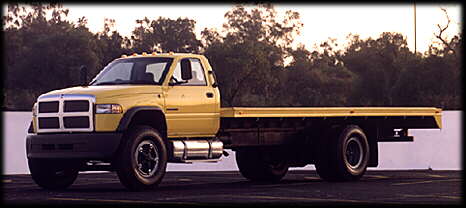
Let me say right off the bat that this would not be a vehicle you could drive in FH5. Very few commercial vehicles can be driven in any Forza game, so this would obviously be a strange AI truck. Given that, we don’t need to go over the specs as you wouldn’t be able to drive the truck anyway. The REAL reason why I won’t go over the specs though is because information on this truck is frustratingly scarce. At this very moment, the most concrete thing I’ve been able to find is the engine options this truck allegedly had. According to some on forums, this could’ve been had with a 360 LA V8, 354 Perkins Diesel inline-six, and the 5.9-liter Magnum V8 in both gas and diesel versions. All of which –excluding the Perkins diesel– could be had on USDM BR-Series RAMs.
Eventually (if I find more information) I’ll do a dedicated article on this beast, but for now, that’ll have to do.
So what do you think? Which of these Mexican Dodges would you like to see in Forza Horizon 5? Let me know in the comments below! As always, I’ll see you all next time.
Credits:
This place: For having what appears to be a press photo of the Dodge RAM 6500.
This forum thread: User Scook6’s post about what engines the strange truck had.
This blogpost: This page also claims it likely used the 5.9-liter Magnum V8.
This Allpar post: Additional information on the second-gen Stratus R/T.
This Turbo Dodge Forum Post: Additional information the second-gen Stratus R/T.
This entire series of posts: For having information on the Magnum, Neon, Stratus, and Ramcharger.