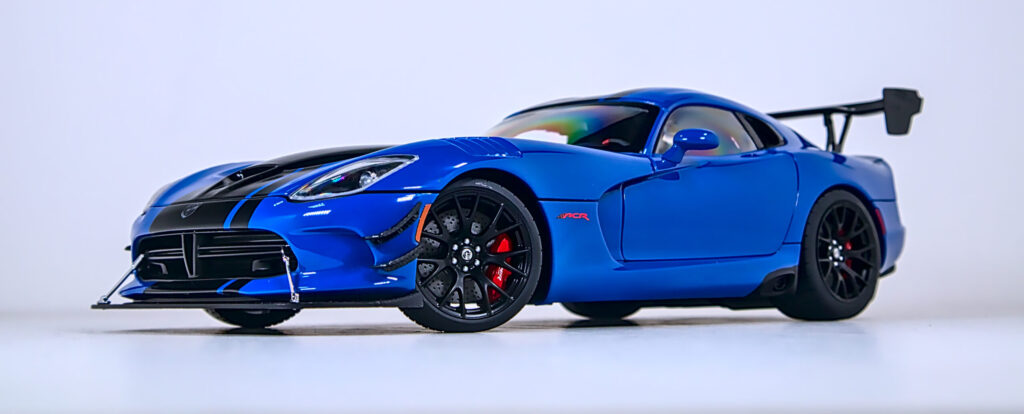


Esteemed readers, today… is a glorious day, for today I finally review my Auto Art Dodge Viper ACR Extreme. This is a special occasion because it looked like it might not happen at all for some years. See, diecast car makers tend not to be tardy when it comes to miniaturizing a new car. The C8 Corvette became a diecast car in under a year if I remember correctly, the Dodge Durango SRT was miniaturized by Greenlight Collectibles in at least a year, the Lamborghini Sian has been miniaturized in under a year, the new Ford Bronco is being miniaturized as we speak, and the Bugatti Divo was miniaturized not long after it came out. Normal diecast producers don’t waste much time at all when it comes to making a diecast version of a new model (usually taking 6-10 months). High-end diecast producers –like Auto Art– seem to take longer (which makes sense considering the quality of their models is far higher). In either case. Diecast companies make a new model either immediately after it comes out, or in a timely fashion. For the Gen V Viper ACR, it took 4 years before someone produced a model! Even now, only Auto Art and one other company (which I’ll get into later) have made a model. Hot Wheels hasn’t, Maisto hasn’t, Bburago hasn’t, Tomica hasn’t, Greenlight hasn’t, and half a dozen other companies have yet to make a Gen V Viper ACR model. As a Viper fan, you might be able to imagine how annoyed this made me. 13 Track Records, the triumph over a million-dollar hypercar at Laguna Seca (the Porsche 918), and all while retaining the things we as petrolheads hold dear, and yet no one had made a model of the newest ACR to grace the Viper lineup. What treason.
However, we can all now rejoice! Our prayers have been answered, our thirst has been quenched, and our hunger has been satiated. The lords at Auto Art have risen to the occasion and given us our son. Ladies and Gentlemen, I bring you… the Auto Art 2016 Dodge Viper ACR Extreme!

Right, now that the ceremony is out of the way, let me clear something up: This isn’t actually the first Gen V Viper ACR brought to market. That title goes to a model made by GT Spirit. That model came out a full year earlier than this model did. The reason why I say it took 4 years is because that model is all kinds of inaccurate. It was and still is a disappointment and not a proper representation of the Viper ACR in a smaller scale, so that is why I don’t count it as the first model. Chronologically speaking it was indeed the first, but it certainly wasn’t the first model to do the car justice (or capture its designs and proportions accurately).
With that chronology error fixed, let’s not waste any time and get straight into the review!
The Front
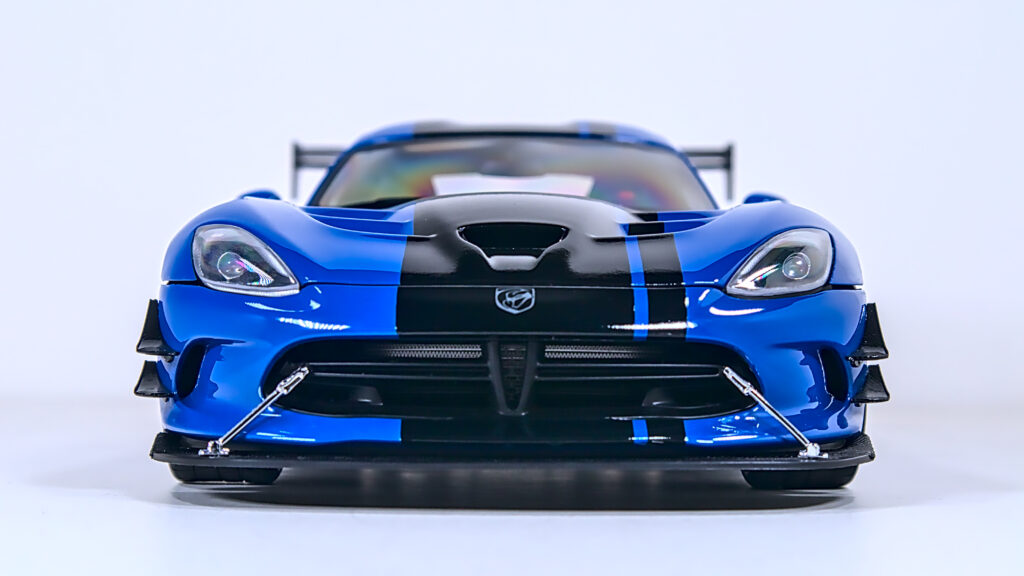
What I like: The headlights (more on this soon), the grille depth, the support beams for the extended splitter, and the canards.
What I don’t like: Maybe the headlights lack a little detail, and maybe the headlight “eyes” are too far back in the part.
Elaborated Thoughts

It wasn’t a coincidence that I listed the headlights as the first thing I appreciate about this model. Every single Gen V Viper model I’ve come into contact with (and seen on the internet) gets this crucial detail of its design wrong. Maisto and Bburago massively simplified it to the point where the DRLs –daytime running lights– and turn signals are nonexistent (leaving the eyes as the only visible detail in the part). Hot Wheels did largely the same thing, Tomica removed all details and just made the lights white, Auto World (not the same as Auto Art) did the same thing, Majorette put Plexiglas in place of the lights, and Kinsmart also put Plexiglas in place of proper lights. This is acceptable for companies that make 1/64th and similarly scaled models because it’s an intricate headlight design to fit in such a small package. It’s not acceptable from companies like Maisto and Bburago, who make models big enough to house such headlight details (those two make 1/18th, 1/24th, and 1/32th scale models). If Auto Art (and to a lesser extent, GT Spirit) can do it, then Maisto and Bburago should be able to as well.
You might make the case that adding such headlight detail (especially for such a complicated piece of design) would drive up the cost of the model, and there might be some relevance to this argument. Let me ask you this though: How much would adding two white strips in the shape of the DRL and turn signal really add to the cost of the model? five dollars? 10 dollars? Don’t get me wrong, I’m not asking them to make a headlight that is exactly the same quality as the one on the Auto Art, I’m saying they could have included the DRL and turn signal details easily within their models and it’s baffling they didn’t.
To its credit, the GT Spirit model does at least have these details, but the overall proportions and the placement of the eyes are bad enough to make a man cry. Some points are won for it having the details but are immediately lost again by the poor execution.

This is where the Auto Art beats all other models by a country mile. The GT Spirit model could only dream of having headlights this proportionally correct and accurate. The DRL and turn signals can be clearly seen without putting your face two inches away from the model and the eye design is the most accurate I’ve seen on any model. It brings me such joy to see that someone finally got this detail of the Gen V Viper right, as it really adds to the realism exhibited by the model.
If there is one criticism, it’s that the eyes might be set inside the headlights a little too far back. Bringing them a quarter of an inch closer to the front –of the glass– would be the only change I’d think about making, but that is nitpicking massively for an otherwise flawless execution of these headlights.
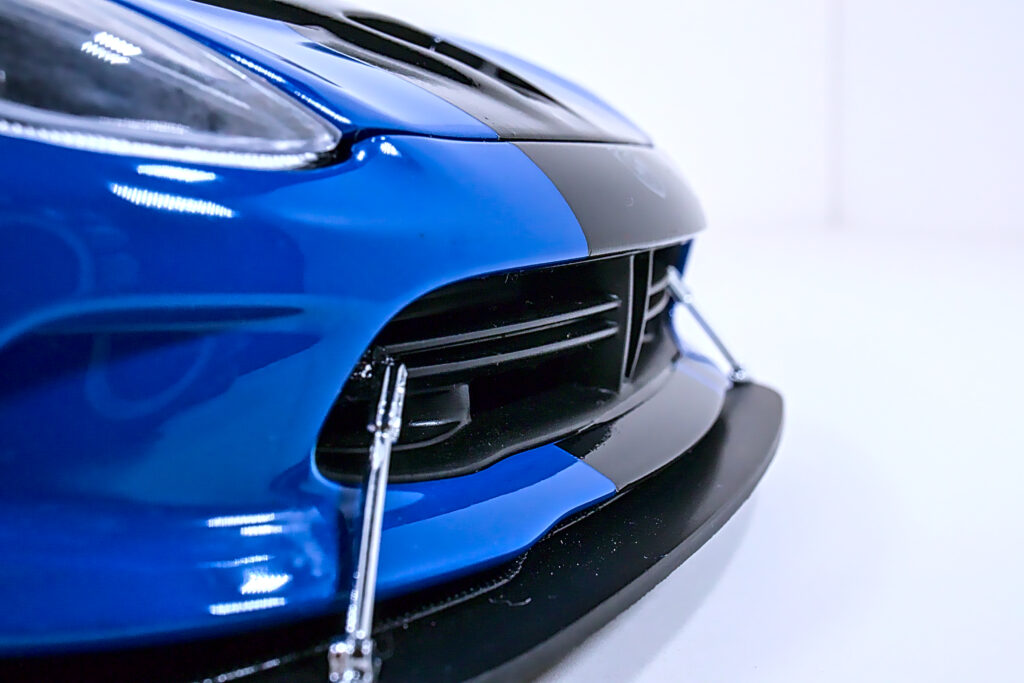
Another thing this model gets wonderfully right is the depth of the grille. Anyone who has a 1/18th or even a 1/24th scale Maisto model of a Gen V Viper knows that the grille isn’t open like it was for prior gen Vipers. It’s not completely flat (mercifully) on the Gen V, but you can’t see the radiator (even though it likely doesn’t have one) either. I suspect this has something to do with mounting points and the (relative) complexity of the grille, but this is still a slight shame nonetheless.
However, father Auto Art is here once again to save the day. Not only is the grille open (HALLELUJAH), but the snakeskin texture inside the V-Shape of the grille is actually present and accounted for! They could have omitted this detail without a second thought (seeing as it is quite minor ultimately) but they didn’t! Auto Art, thank you for paying attention and implementing this small detail into the model, as well as giving the grille some genuine depth.
Bonus:

Look at the quality of the support beams for the splitter extension and the canards. You can see the carbon fiber detail on the canards beautifully, and the extensions don’t look like cheap plastic afterthoughts.
The Back
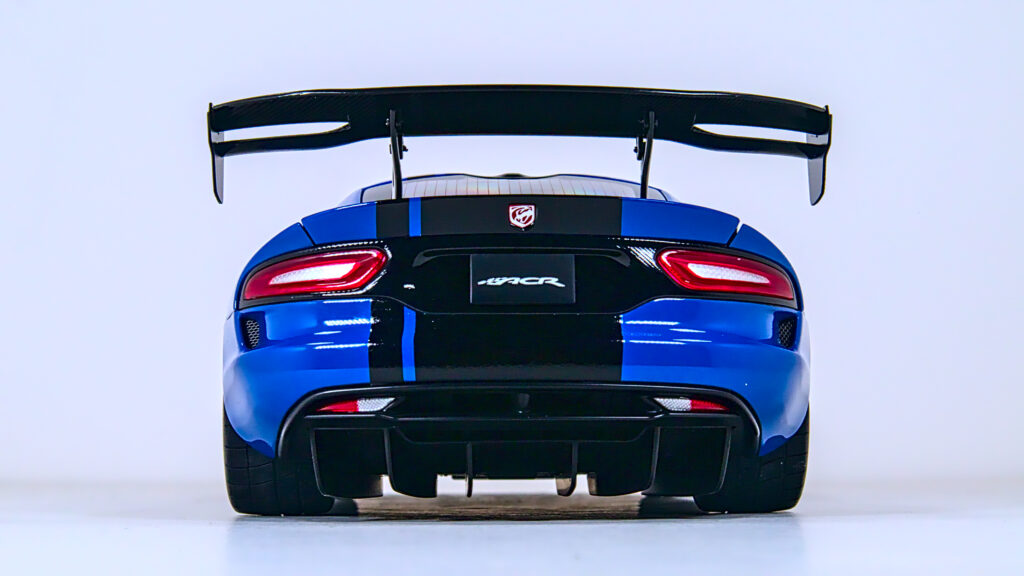
What I like: The stance, the ACR license plate, the integrated stryker logo into the third taillight, the depth of the diffuser (the normal one not the ACR-E specific ones), and the aggressiveness of the ACR-E diffusers.
What I don’t like: Nothing.
Elaborated Thoughts:

Unlike with the front, few companies get the rear of the Viper wrong and Auto Art is no different. Everything modeled correctly on other diecasts is also modeled correctly here and then some. On my red 1/18th scale Maisto model, the reverse lights and reflectors in the rear diffuser aren’t present (whereas they are on the Auto Art). It’s totally unimportant for the most part, but the inclusion of such details on the Auto Art does wonders to sell the idea that they just shrunk a real ACR Extreme. They’re little details for sure, but those little details add up.
Speaking of the diffuser, there’s no black plastic closing off the back on the Auto Art. It’s open, and you can see into the model (though only minimally). The Maisto, as you probably guessed, is closed off. It doesn’t lack texture (they didn’t just smooth this area over), but it’s one of a few things that impair the realism of the model. That said, if they left it open, I would imagine the only thing you would see is a very non-realistic-looking chassis, so perhaps this is a necessary (minor) evil.
Even with some of the criticisms I have of the Maisto, there’s no denying that this is where it and the Auto Art are the most similar. Maisto (for all my little quibbles about the model) has done a very very good job replicating the Gen V at its price range. When I look at my Auto Art and the Maisto side-by-side, it’s almost like I’m looking at the same car but in two different trim levels (instead of looking at “Maisto’s interpretation” of the Gen V and –for the sake of argument– “Bburago’s interpretation” of the Gen V). This isn’t a review about the Maisto though, it’s a review about the Auto Art, so let’s get back on topic.
As I said earlier, this car gets the rear-end of the Gen V right and then some. You know the little ports below the taillights? Not only are those sunken into the bodywork correctly, but they’re open! If you look at just the right angle, you can actually see into the rear wheel well! How. Cool. Is. That!? I’ve never had nor seen a model where so much of the functionality of the real car was preserved in the model! Especially for a detail that is so small, there must’ve been difficulties getting the exhaust mesh in there (and keeping them open). Absolutely astonishing.
The whole presence of the rear is incredible. It has just as much “wow factor” as a real ACR does and that, to me, is a high compliment.
Bonus:

See? I wasn’t lying! You can legitimately see through the rear wheel-well port!
The Side

What I like: The silhouette, the wheels, the ACR sticker, the carbon fiber brake/diff cooler, the hood louvers, the wheel gap, and the side pipe detail.
What I don’t like: The black area surrounding the side pipe doesn’t cover the bottom of the wheel arch properly.
Elaborated Thoughts:

The side view of the Gen V Viper is one of my favorites views in the whole automotive world. Here, the coke-bottle shape is in full view, the side gill adds movement to the body (as well as flair), and the classic “long hood, short rear” design proportions are accentuated. Truly, it is one of the most satisfying profiles I have ever seen on a car (past, present, and possibly future).
Happily, this is something I can say of the diecast car as well. All the previously listed Viper styling cues are here in spades, and things only get better with the ACR Extreme. The Viper already has a pretty crazy (though familiar) side profile, but with the massive splitter, canards, and gigantic wing, the car cuts a profile that can only be described as pure racecar. You’ll hear this a lot throughout the review, but Auto Art barely missed anything with this model.
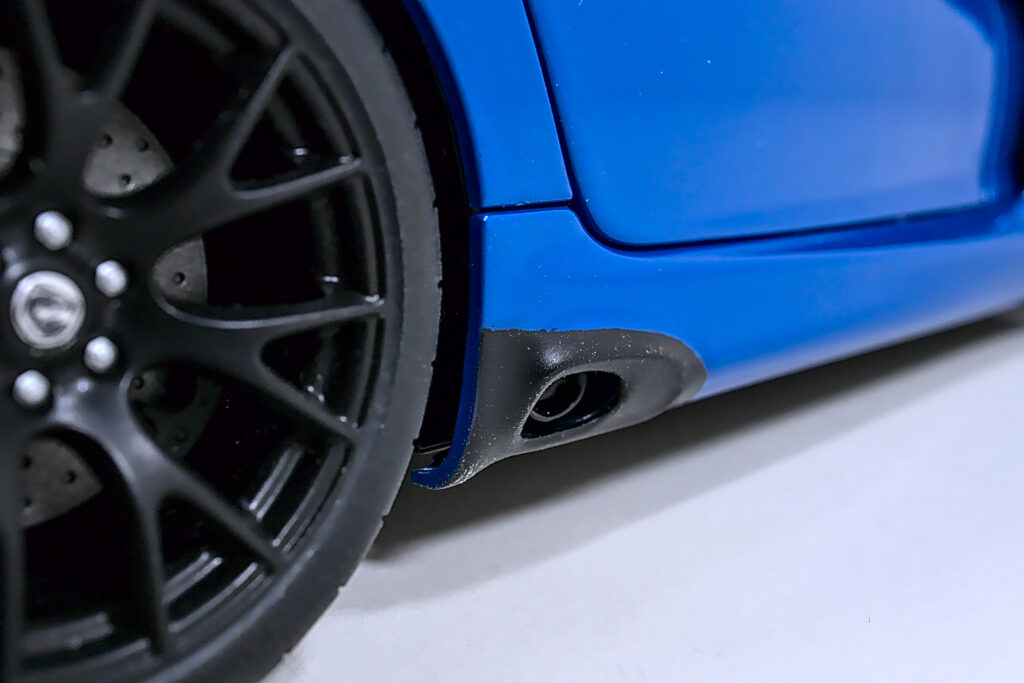
Sadly, however, they did miss one thing: Making sure the black surround for the side pipes continued –briefly– into the wheel well. If you look closely (and at an angle), you can see that the color of the body peeks through where it shouldn’t. “Cody come on, that’s such a minor detail, you’re not serious, are you?” Unfortunately I am. I don’t disagree that this is a small detail (because it is), however, it’s one of those irritating little things that’s hard to gloss over.

On a happier note, there are other great things to gawk at! Like the carbon fiber on the brake/diff cooler (as well as the quality of the design element itself). Along with the headlights, this is a common sore spot for small Gen V Vipers (between 1/64th and 1/32nd scale versions), so I’m glad to see another “big” model Viper hasn’t succumbed to this issue like its smaller brethren have.
As with everything else, it also goes a step further than any other Viper model on sale by adorning this design feature with carbon fiber! All other Viper models I’ve seen up to this point have this element in plain black (which is fine, but common). I’m a sucker for carbon fiber so seeing some well-designed (likely fake) carbon fiber on a well-executed brake/diff cooler warms my heart.
Bonus:
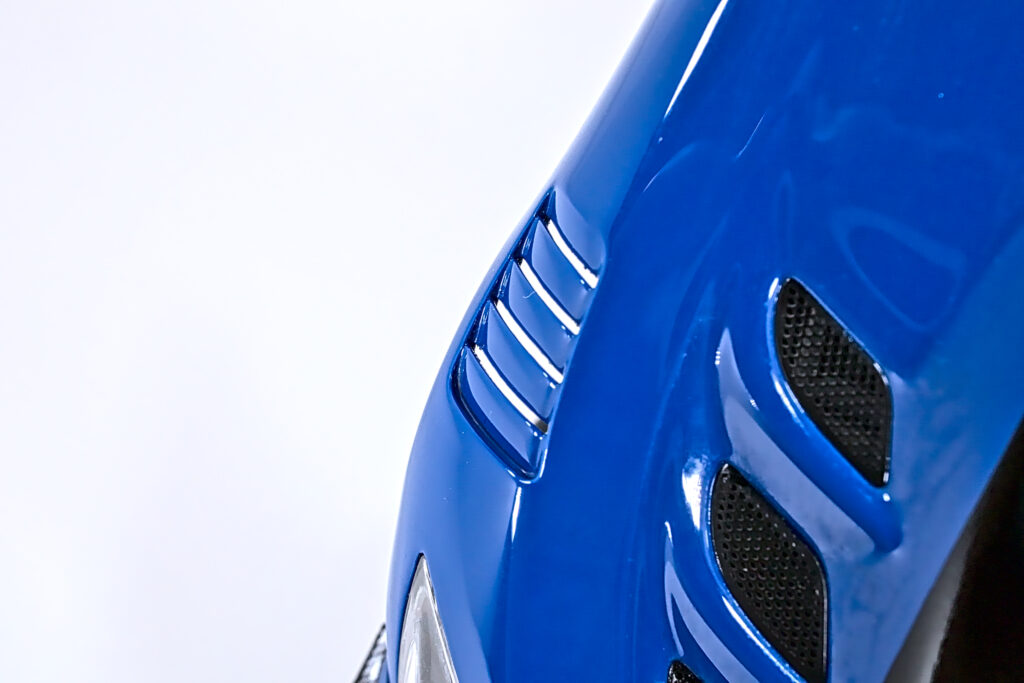
Check it out, even the hood louvers are open! Considering the severe lack of space in between each slit, it impresses me immensely that Auto Art stuck to their guns here too and made sure the louvers were open (and maybe functional?)
The Top

What I like: The stripes, and the open vents on the 6-vent hood (oh yeah, we’re talking about that soon).
What I don’t like: The stripes (more on this soon).
Elaborated Thoughts:
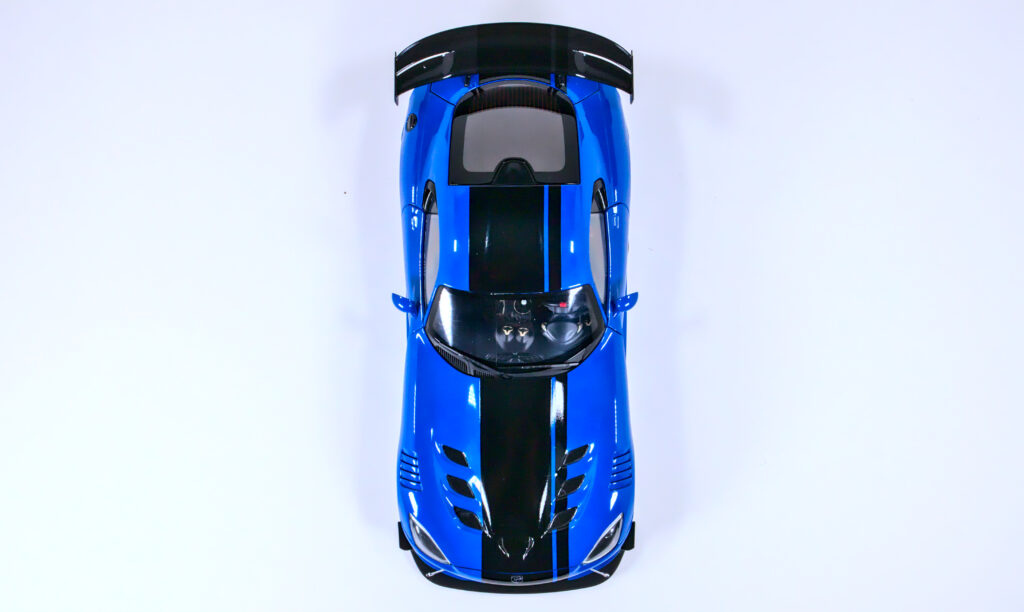
Unlike with other areas of the car, I don’t have that much to say here. As such, I’m going to stick to the basics and air my thoughts with little fluff. Let’s start by talking about the stripes: They’re really good. You have the traditional ACR center stripe with the ACR driver’s stripe, and it runs the full length of the car and even goes over the wing. I haven’t seen any sloppiness with the edges of the stripes and they fit the contours of the Viper exceptionally well.
However, it’s not all positive. Unfortunately, rather than being painted onto the car, the stripes are just stickers on the body. This means that the seam for the sticker can be observed under the right lighting conditions. Credit where credit is due, said seam is pretty much invisible under any other circumstance, but it couldn’t hide forever. I don’t find this to be a big deal but I’ve seen some people across the internet express some disappointment about this. If this a problem for you, then I recommend you get the white GTS-R. Its stripes are painted onto the body and you have the benefit of those stripes being metallic blue (rather than the flat black stripes of my blue model).
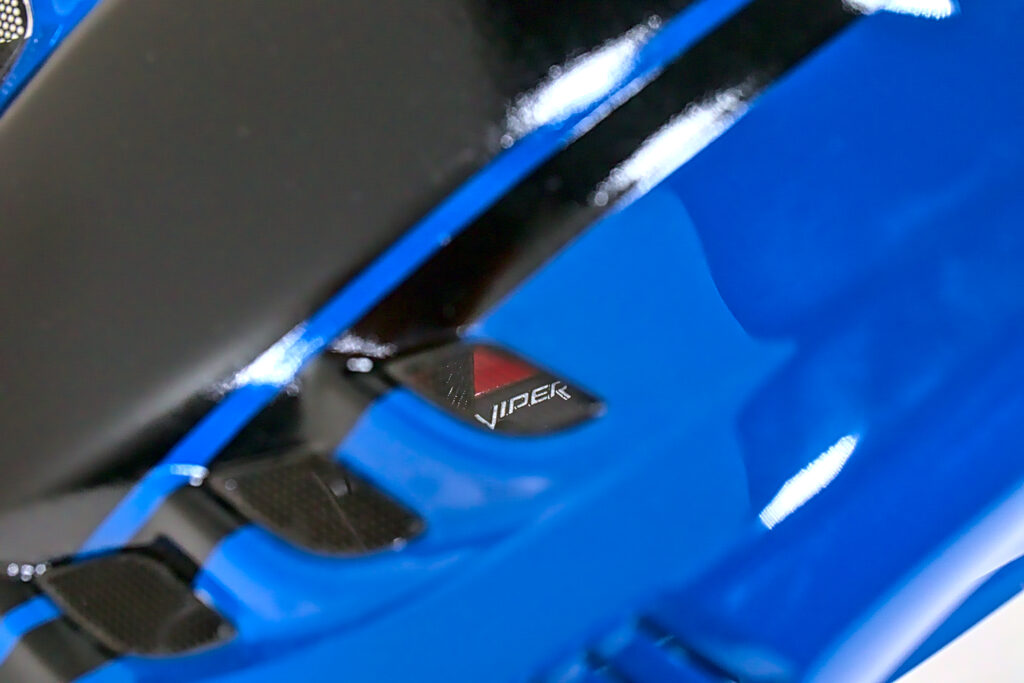
Moving on to the 6-vent hood, I wasn’t kidding when I said that they were open. In the above photo, you can clearly see that the engine is visible through the vents in the hood. Again, I have never seen nor owned a diecast car where so much of the functionality from the real car was preserved in the small-scale replica. I don’t think you can remove these vents like you can on the real car (not without potentially hurting the model at least), but this is more than enough. How Auto Art manages to get the mesh for these details so small without closing them off entirely is beyond me, but I’m glad they’ve got the know-how to keep vents like this open.
Bonus:
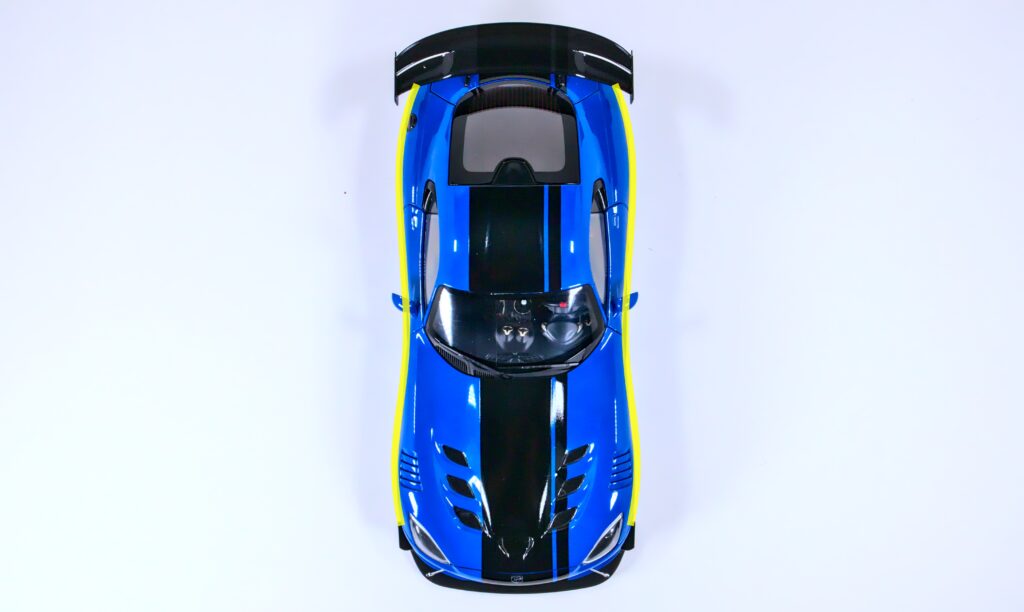
For the Viper, usage of an hourglass figure doesn’t stop at just the sides. Viewing it from the top, it’s obvious that the car is wider at the front and back –even from the top– than it is in the middle.
The Bottom

What I like: The modeling of the undertray (it looks like it does on the real car), the engine modeling, the visible suspension arms, the port on the bottom for diff cooling, the inclusion of little ducts (under the car) for front brake cooling, and the correct length of the diffusers.
What I don’t like: Nothing
Elaborated Thoughts:

This is my first time getting a model of this quality, so excuse me while I geek out over something that is probably commonplace for models of this caliber: WHO THE HELL DECIDES TO ACCURATELY MODEL THE UNDERSIDE OF A DIECAST CAR!? Not only did they get the placement of items correct, but they also got the little details correct as well! The oil pan is shifted slightly to the passenger side like it is on the real engine! That’s not a mistake either, as the whole engine is actually positioned slightly towards the passenger side on the real car. Dodge did this so the weight distribution side-to-side is more even when the driver steps into the car (stuff like that just goes unnoticed and unappreciated by most of us). Beyond that, they modeled the suspension arms (who does that!?), the little ducts for front brake cooling, seemingly the oil filter, and some of the frame rails. Like I said at the beginning, I’m sure this is common practice for models of this caliber (and certainly for models from Auto Art), but they really take the “Art” in their name deliciously seriously.
Bonus:
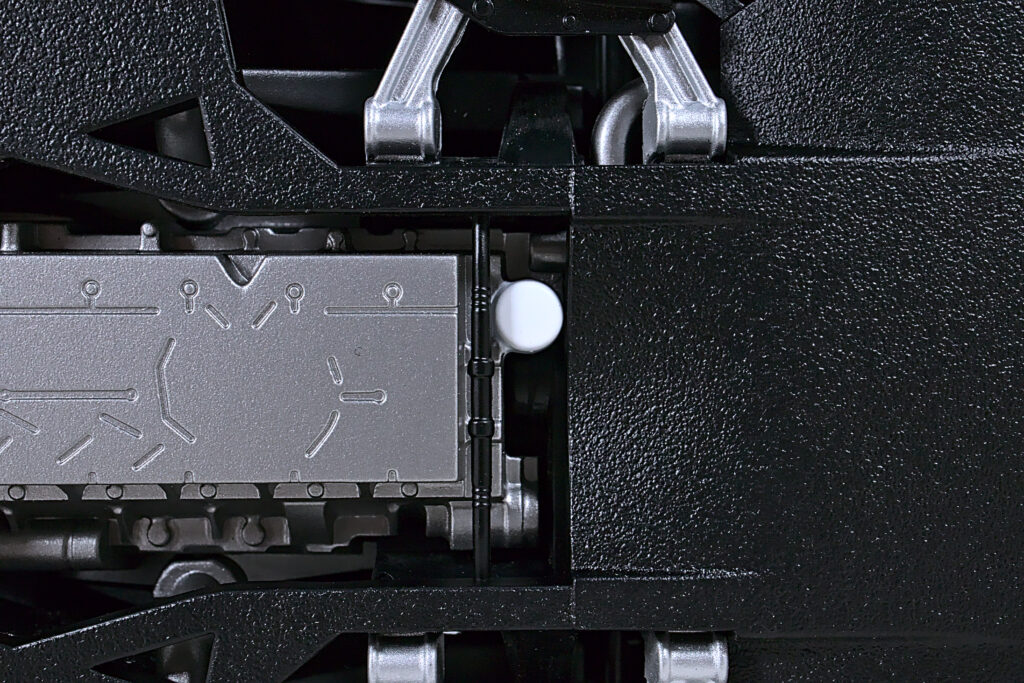
I’m not completely sure if this is truly the oil filter, but it’s something for the engine and I applaud them for including it!
The Interior

What I like: Almost everything.
What I don’t like: The lack of detail on the seats.
Elaborated Thoughts:

I know I know, the previous section wasn’t that conclusive, I just don’t know where to start though! The whole model has a level of attention-to-detail I’ve never encountered before and the interior adds to that enormously. It’s one thing to get the outside right on a model car, it’s a different thing entirely to accurately and extensively detail the inside of a model car (which Auto Art has done here)! From the nice fuzzy carpet lining each footwell and the trunk space, to the red-colored seatbelts lightly covering the seats, the interior might just be the best thing about the entire model (OK, second only to the overall presence the exterior has). The instrument panel has an expertly placed sticker for the TFT screen and the gauges flanking it, the uConnect 8.4-inch touch screen is also skillfully placed and showcases a genuine menu you would see on a real ACR; the gold highlights for the air vents, instrument panel outlines, “oh crap” handle, and other areas are gold like on the real deal; and Auto Art even modeled the god dang dead pedal! Clearly, they are committed to their craft.
It isn’t that we haven’t seen most of this before (cough in the Maisto cough), it’s that this model does everything its less expensive counterpart does but much better. The fit and finish is better, the quality of the materials (obviously) is way better, and the proportions of some of the interior details is better (like the “oh crap” handle). It’s quite frankly a better-executed version of the Maisto’s interior (I suppose it ought to be though, considering this a near 200 dollar model).
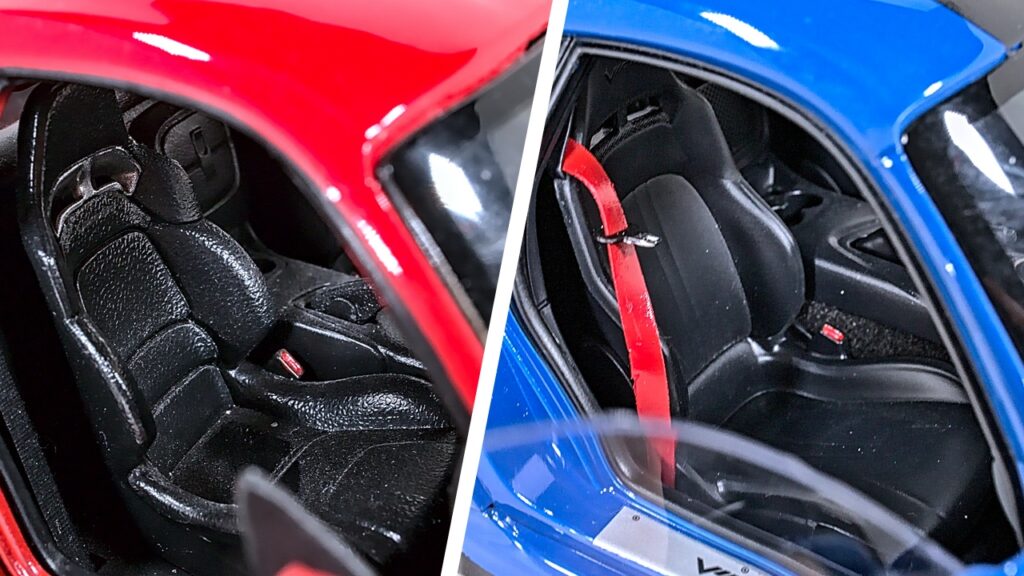
However, the one area where the Maisto triumphs over the Auto Art is in the detail on the seats. For the Maisto, the indent that separates the headrest area from the seat bolsters is way more prominent than it is on the Auto Art. On real Gen Vs, the surface on the headrest is somewhat different from the surface on the bolsters, and there’s a noticeable seam where the lower three-quarters of the seat meets the upper quarter (the headrest). Auto Art didn’t model this seam nearly as prominently as Maisto did, and the result is a seat that looks like one massive piece (rather than various little pieces put together like on the full-size car). Not a big deal, but this is a weird area for the Maisto to excel in and for the Auto Art to be “meh” in.
Bonus:
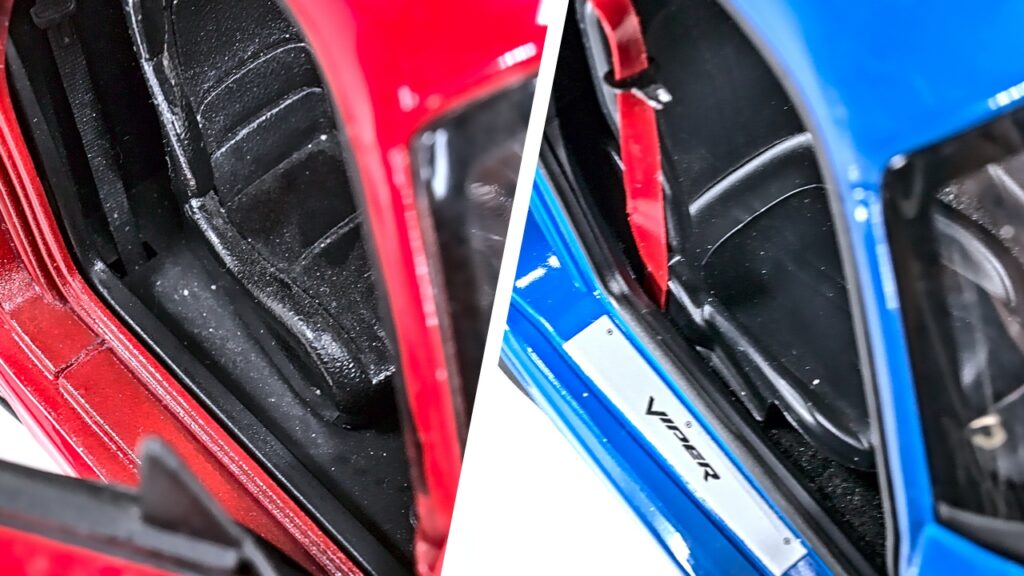
Here’s an example of where the Auto Art has better interior proportions than the Maisto. The seats fit far more snugly in the Auto Art interior (likely due to them being wider) than they do in the Maisto interior
The Snakepit: The Auto Art vs The Maisto
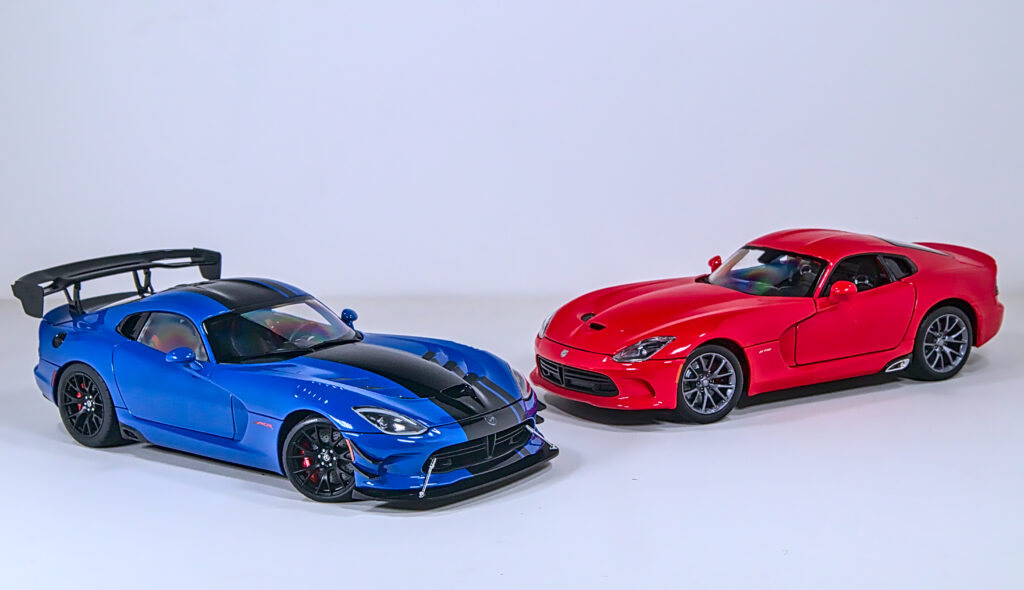
“So is the Auto Art genuinely worth the price difference over the Maisto? I mean, judging from some things you’ve said, the disparity between the models doesn’t seem justified.” This is how I felt upon first glance when I opened the box all those months ago. Outside of the ACR aerodynamic additions, the fundamentals looked (and still look) largely the same, so where’s your money really going? Allow me to show you all the differences between the two.
The Hood Fitment:
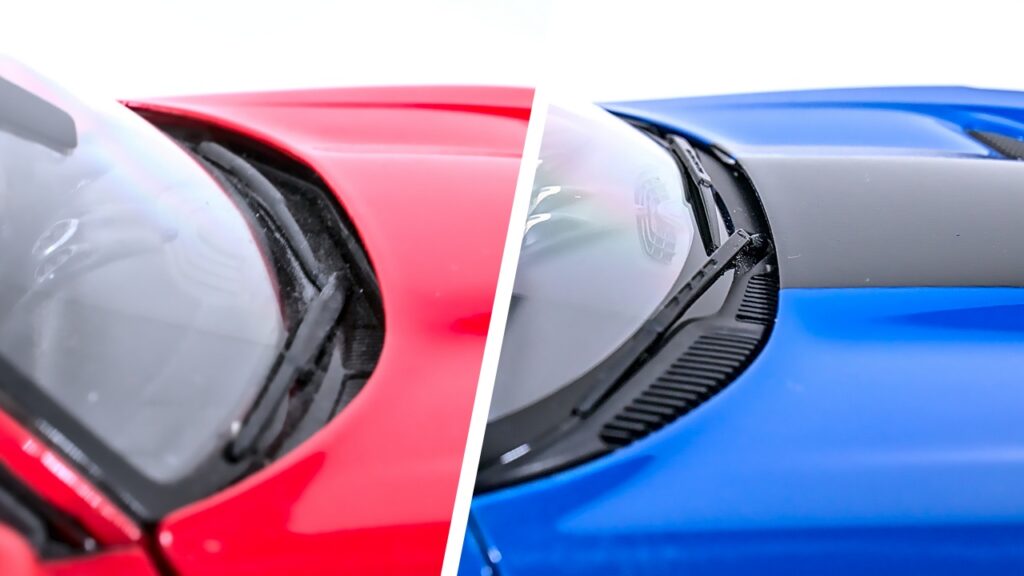
As you can see in the photo, the Maisto’s hood does not fit that neatly onto the dash cowl. It’s not abhorrent, but there is a noticeable gap. This isn’t something I realized until I got my Auto Art when I saw the difference between the two. Even in the photo above, you can see for yourself how millimeter perfect the Auto Art’s hood is, and how “imprecise” the Maisto’s hood is.
The Open Hood Vents:
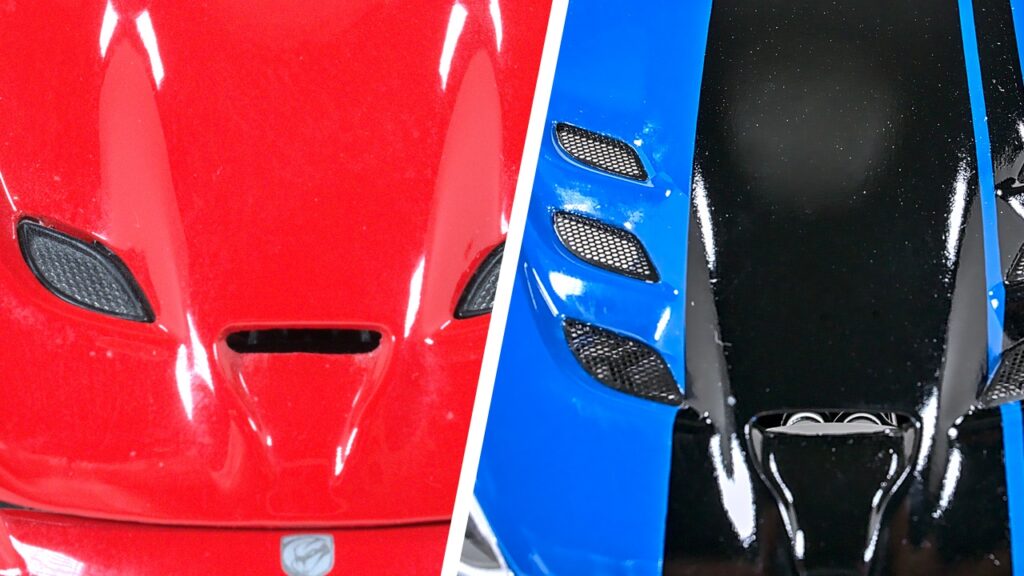
Those of you who don’t have short memories will know how I was enamored by the fact that these vents were open. To this day I’m surprised they managed to make a mesh this small yet keep the holes so open. Obviously the Maisto lacks open hood vents like this. The vents do have a pattern simulating grille mesh, but they’re not actually open and the mesh isn’t really there.
The Engine Detail:

Here is the real secret weapon of the Auto Art. Look at the crispiness of that engine bay, the clarity in the details, the accuracy of the components, and the overall execution. The real-life engine-bay is something to behold and Auto Art has recreated that sense of awe here. I actually used an image I took of this engine bay and made it my phone wallpaper and it darn nearly looked like the real thing. Every part looks individually modeled, then added into the engine bay to create the full picture afterward. This means that there’s genuine dimension to the components, which –again– helps to sell the realism.

The Maisto, on the other hand, suffers greatly in comparison. It’s not bad all things considered (especially for the price), but you can tell it’s just one massive piece that neatly and cost-effectively fits into the engine bay, where only the most visible parts of the Viper’s heart have been modeled. Again, it’s good for the money, but totally outclassed by the Auto Art.
The Accuracy Of The Headlights And Taillights:
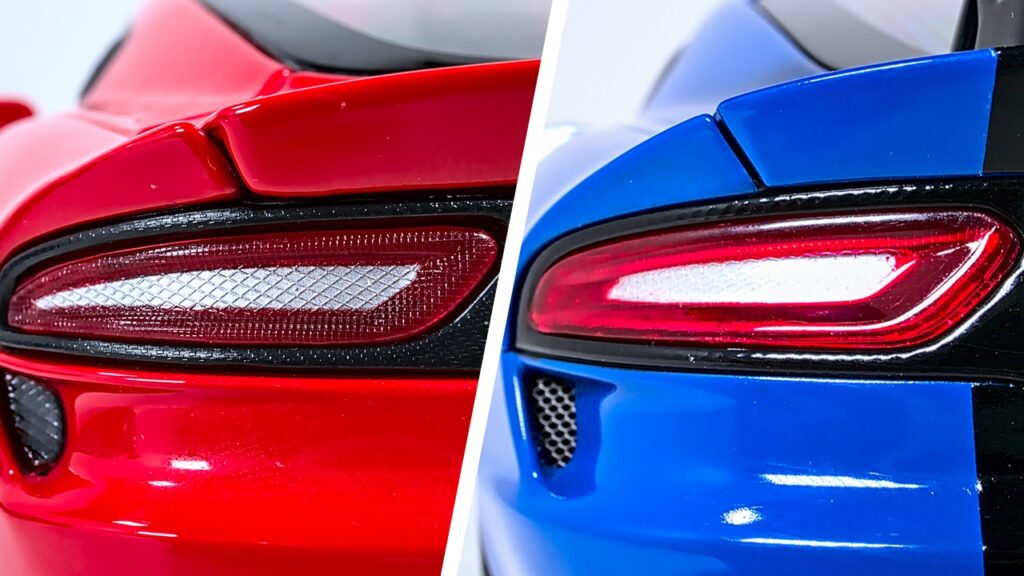

Yes yes I know, I already talked about the headlights, but while writing this article I realized that the taillights on the Maisto aren’t as good as I once thought. In the photo above, you can see that the turn signal section of the taillights is far too long on the Maisto model. This seems to be due to the brake lights (which surround the turn signals) not being thick enough, thus allowing the turn signals to continue for longer than they should.
I could touch on the headlights, but I already have and you can see the monumental difference in the photo above, so I’m just going to move on.
The Rear Window Detail:
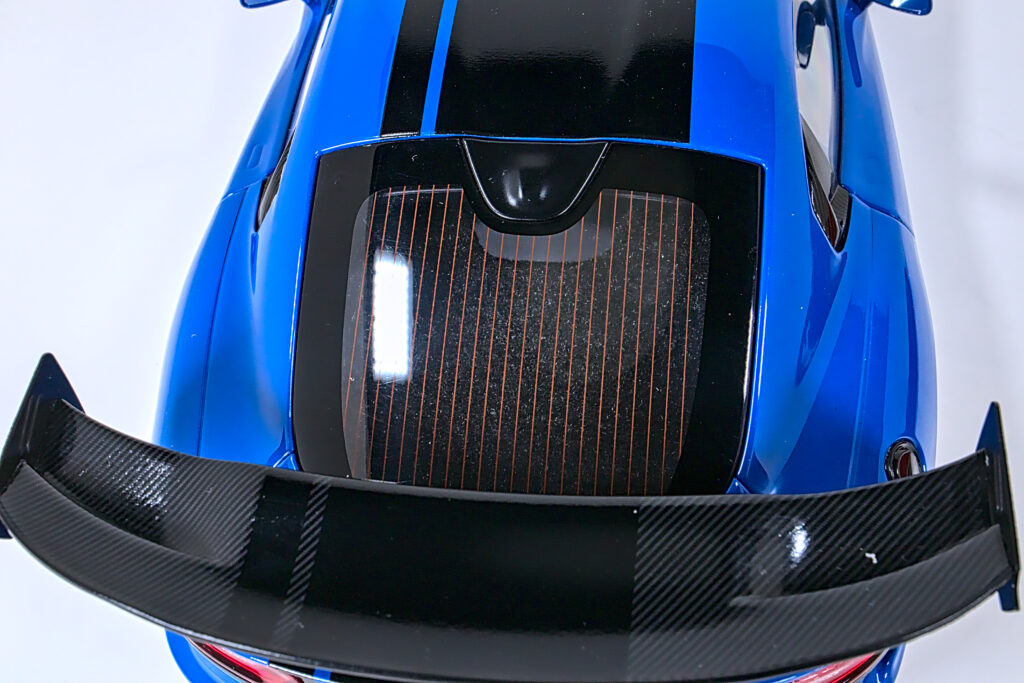
Do you see it? You see that? Auto Art genuinely added the rear window defroster lines into the rear window of the ACR model. That is incredibly thorough! Of all the minor details, this has to take the cake for the most unnecessary yet awesome inclusion of any detail I’ve seen on this model (or indeed any model). They. Didn’t. Have. To do this. No one would’ve batted an eyelid if they ignored this detail for the model. No one would’ve cared nor likely even noticed upon first glance that this detail was missing, yet they added it anyway. Small. Details. Matter.
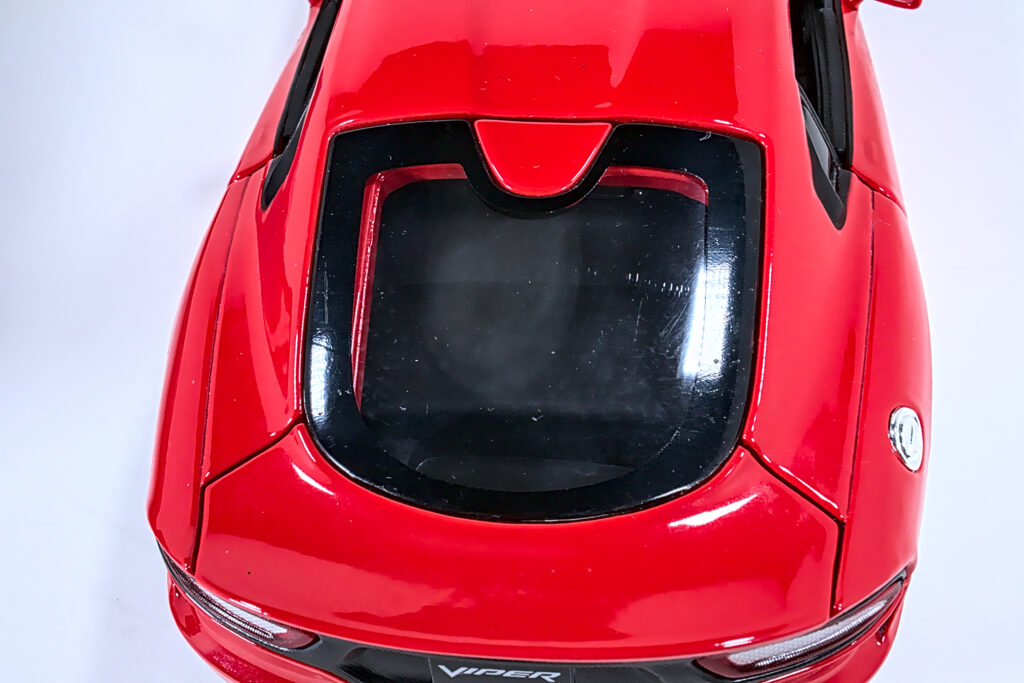
While the Maisto does omit this small element, it’s the least consequential omission on this model yet, so it doesn’t lose any points here.
We’re not done yet though, for there are other elements on the model I haven’t even talked about yet. Let’s fix that.
The Wing:
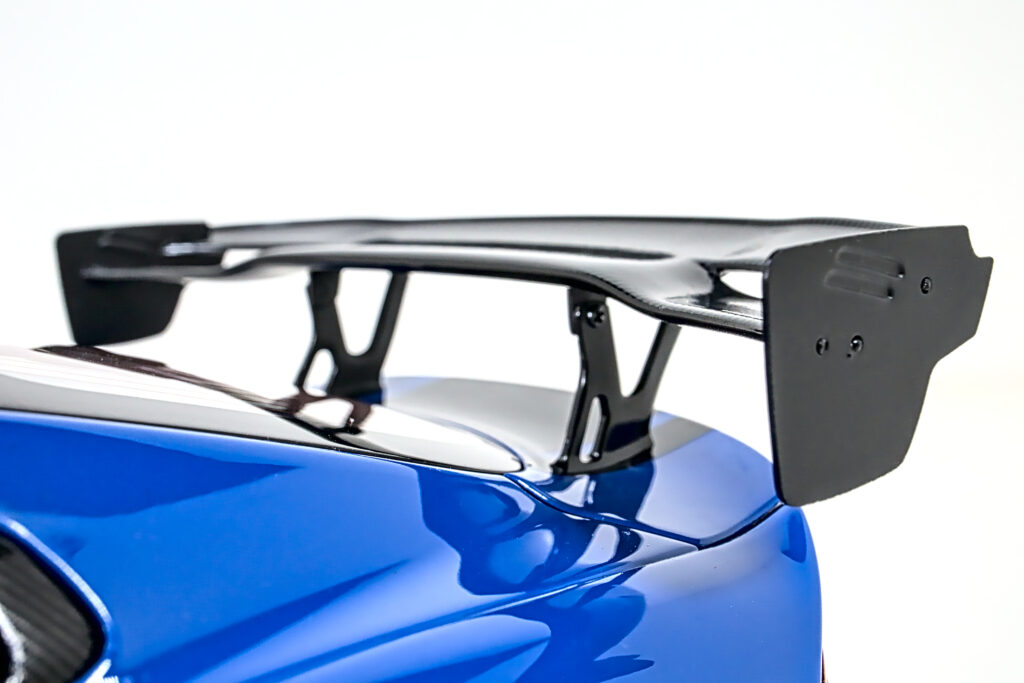
No, I don’t think it has exactly the same shock value as the real wing. How could it? It’s not nearly as big as the real deal (which is already massive for a full-size aero element). However, in scale, it does look pretty dang gnarly nonetheless. I mean hell, the wing still sticks above the roof of the car! You don’t have to have an identical level of grandeur for that to be awesome!
What’s also awesome is that the wing has been modeled in carbon fiber (with the center and driver’s stripe going on top). I love me an ACR with a painted wing, but I think that would’ve been the wrong choice for this paint scheme (as the GTS-R pulls it off spectacularly).
Unfortunately, it isn’t totally flawless. Thankfully the wing itself seems to be pretty sturdy (despite its small size and thickness), but the hatch it’s mounted to –on my model– does have a little bit of play in it if I push down carefully on either side of the wing. If you’re like me and have never had a model this expensive before, it certainly adds an uneasiness to your handling of the hatch. The wing itself though is top-notch.
The Weight:

Speaking of uneasiness, we need to talk about the weight of this model (and or the lack of it). Thanks to it being made of a composite material (rather than a metal) it is unnervingly light. Despite having more details and better-executed details than the Maisto (as well as a wing, diffuser, and a huge splitter), this model is actually lighter than my Maisto SRT Viper GTS. To car guys that sounds like a good thing (“weight reduction bro” right?) but the reality is that this leads to the model feeling… ugh, I hate to say it, but somewhat flimsy in two areas: The hood and the hatch.
We all know that Vipers with a clamshell hood (Gens 1, 2, and 5) weren’t known for having the most rigid hoods, and unfortunately, you get that same experience with the Auto Art model. Attempting to open the hood –because it clicks into place– is like delicately trying to open a snack bag. Too little force and it won’t open, too much force and you’ve spilled Doritos all over the floor. It’s a very delicate balancing act between using an iota of your power to open the hood, but not going one percent Shaggy and ripping it off.
The hatch is like this as well. It doesn’t click into place like the hood, but you have to open it a certain amount for the tiny gas struts to hold it in place; side note: Those tiny gas struts likely add cost to the model and are present for the hood as well. Back on topic, you won’t initially want to open the hatch as far as it’ll go, because it feels like the struts will break. You can’t get away with opening the hatch less, because the struts don’t have the angle necessary to hold the –minimal– weight, so you have to ignore the warning in your head that you might break the hatch and open it further anyway. It does become less disconcerting over time, but not entirely so.
The Wheels and Tires:
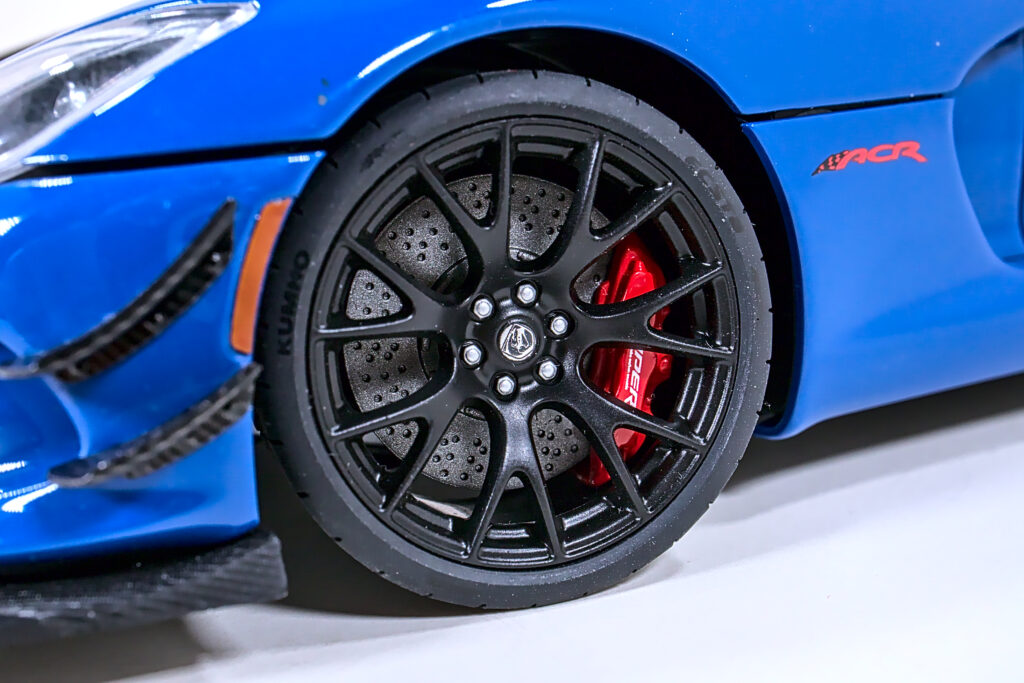
Oh yes, there is something to talk about when it comes to even the wheels. Look at the quality of them! Crisp, clean, and detailed! For starters, you can see the 6-lug nuts easily on these wheels (which you can’t on the Maisto, though the color doesn’t help), the hub cap has a little Viper logo that’s well implemented (that is to say: You can see it), there are no inaccuracies with the spokes, and they cover the brake disc plus caliper perfectly. Again, the entire execution is fantastic.
Speaking of the brake calipers, they’re exquisite! The white text on them can be seen clearly, it looks like a proper caliper (rather than a small red arch on top of the brake disc), and red brake calipers provide great contrast for this largely blue and black Viper.
The brake discs are also pretty cool in their own right. This is primarily because when you spin the wheel, they spin too! The calipers stay in place, but the discs move with the wheel (as they do on real cars). This is yet another detail I have never seen on a diecast car and it’s another detail Auto Art didn’t have to implement but decided to anyway! Auto Art: Yous a real one. That aside, their color is also satisfactory and the fake drilled holes are a welcome inclusion to one of the most important components on the ACR.

Moving along to the tires, it’s evident that little was ignored here as well. Even though the sidewalls aren’t as detail-rich as other areas are on this car, they do at least have little “ACR”, “Ectsa”, and “Kumho” text on them that lets you know Auto Art was paying attention here as well. Amazingly, this isn’t the only element to the tires they added onto the model, as they even made sure the tread pattern for these very specific tires were authentic to the real item. I suppose some of you are tired of me being amazed by everything on this model but I can’t help it! I’ve never seen a company pour so much time and effort into making sure a model was so accurate to its full-size counterpart.
The Steering:

You know how most lower-end diecast car’s steering doesn’t stay turned in either direction? Not a problem with the Auto Art. Whether you turn the wheels left or right, they stay there as they should. I don’t know what steering system Auto Art uses, but it’s a joy not to have auto-return steering on a diecast car, it makes holding poses for photos much easier.
The Trunk:
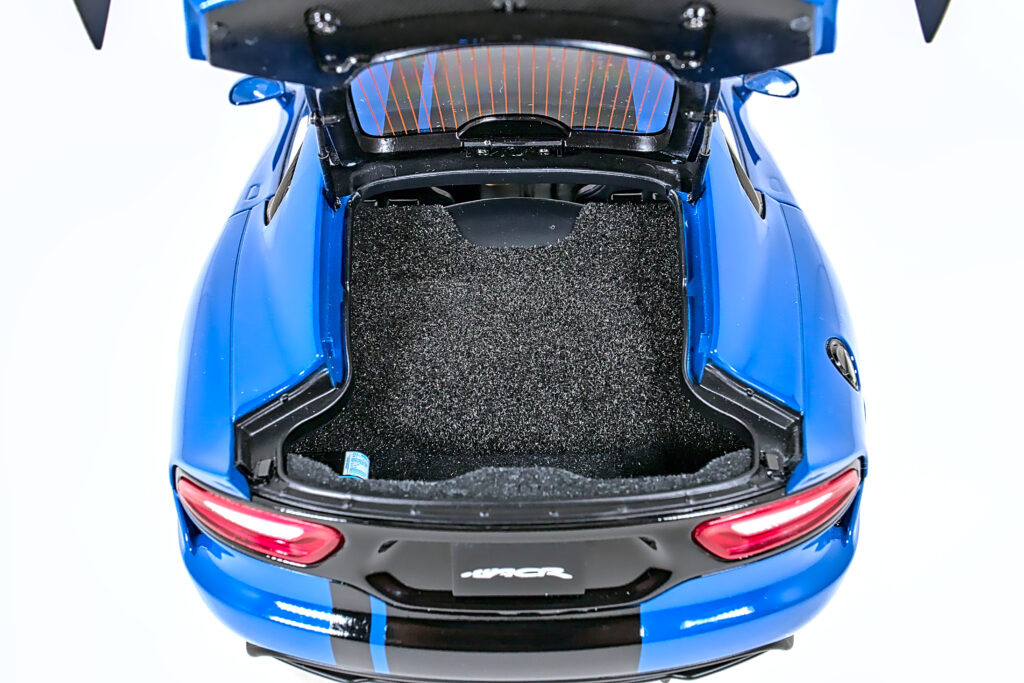
No no, I’m not bringing this up to pad my word count so I make it to 6000 words (though that is a nice side benefit). I bring this up because the trunk is the home to the biggest inaccuracy of the entire model. Do you notice anything in the photo above? Do you see it? It’s a minuscule error, but Viper faithfuls will see it immediately.
Tired of guessing? Alright, here’s the error: There’s carpet in the trunk. If you cast your mind back to 2015, one of the notable interior features of the ACR was its lack of carpet in the trunk. This exclusion actually allowed you to see the piping for the rear brake/diff cooler! I’m not that bothered about the fact Auto Art added carpet here (especially because I love running my finger through it), but I find it funny that they added a “luxury” option that wasn’t present (for weight savings) when the ACR came out. In fairness, you could order an ACR through the one of one program and get carpet, so this less of a grave error and more of a funny tidbit.
The Dive Planes:
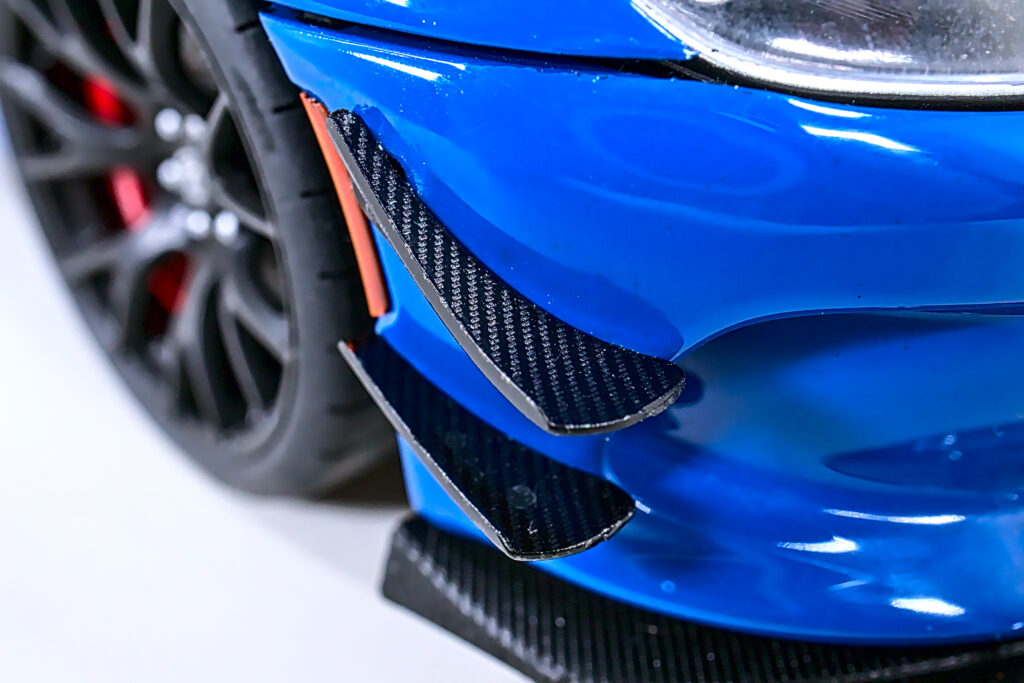
When it comes to the ACR, my second favorite thing about the front end (just behind the splitter) is the dive planes. Dive planes always add so much aggression to a car and –if I’m being honest– I’m a sucker for aero bits. In regards to the Auto Art, the dive planes are exceptionally well mounted. Fitting, as far as I can make out, flush to the bodywork of the front bumper. I also find it impressive that they managed to prevent the paint from spilling onto the canards, but this is likely because the dive planes are a separate piece from the front bumper (which is true, just see for yourself). The fact that they modeled the whole canard(s) in carbon fiber brings me much joy, and they seem to have gotten the placement on the bumper right as well.
Conclusion
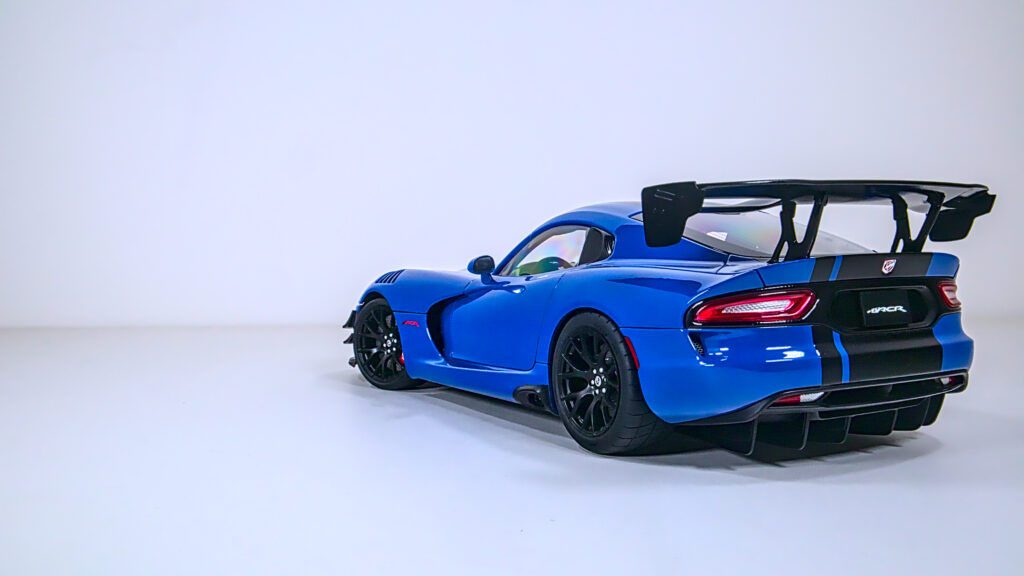
Man! We sure went over a lot in this review. It’s a little difficult to decide where I should begin, so I’ll start here with this question: “Is it worth 200 dollars or more?” In my opinion, it’s not. Don’t get me wrong, it shouldn’t be 80 dollars or something like that, but even with everything I geeked out about earlier I don’t believe it should cost that much. For me, I have a hard time looking at the Auto Art then looking at the Maisto and saying “yep, that’s a near 200 dollar difference right there” when the Auto Art doesn’t fundamentally change anything from the Maisto (excluding the headlights). The side gill is pretty much the same on both models, the exterior proportions are the same on both models, the front ends are more similar than different, and both –crucially– look like a Gen V from not that far away. When viewing both models through this lens, it’s hard to see why you should spend so much more on an ACR version of the same Gen V you can get for far less from Maisto.
However, as I’ve said throughout the entirety of this article (or just about), all those little differences and details make a difference. From the completeness of the interior to the modeled undertray and chassis, the Auto Art Viper ACR is a masterclass in how to properly capture a real car in a much smaller scale. The Maisto looks like a really good diecast Gen V Viper, the Auto Art looks like a Gen V Viper shrunken down. That’s the gap between the two.
I still don’t think it should be a 200 dollar model, that seems a bit overpriced to me. However, if it was a 150 dollar model (like the GT Spirit) or a 170 dollar model, then the price would be perfect. It is unquestionably a 100+ dollar model, I simply don’t think it eclipses the 200 dollar mark.
Secondly, would this model be good for a kid? I don’t think so. This model isn’t as robust as normal metal diecasts, which means it’ll easily fall prey to the rambunctiousness of an 8-year-old or the carelessness of a 12-year-old. If you want this model to last in the hands of your child, it either needs to be stressed how delicate the model is, or you’ll have to tell them to wait until they’re a little bit older.
Lastly, is the model really as good as I said it was? Yes. You might think I’m biased because I’m a Viper enthusiast, but you should know that I avoided picking up the GT Spirit despite the fact it came out about a year and a half before the Auto Art did. I was greatly disappointed by the photos I saw of the GT Spirit and wasn’t willing to pick up my first ACR model if I wasn’t going to like it, so I waited for the Auto Art because it looked far more promising. If the Auto Art looked just as bad, I wouldn’t have picked it up either. I had bated breath that this model would be good, all my hopes and dreams that someone finally made a good ACR model rested on the shoulders of Auto Art, and I can tell you right now that they delivered and then some. The superbly modeled headlights, taillights, wing, wheels, interior, vents, louvers, engine bay, chassis, undertray, diffuser, splitter, dive planes, pretty much everything is a testament to this model’s excellence. Out of 10, this model is a perfect 9. There may be small nitpicky things here and there, but they hardly take away anything from this splendid creation. I can’t thank you enough Auto Art, my prayer for a proper Gen V Viper ACR Extreme model was answered, and you provided everything I was looking for and more.
What do you guys think though? How do you feel about the model? Is it fantastic, or could they have done a few things differently? Let me know in the comments below. Not only is this the end of this review, but this is the end of Viper Week! I sincerely hope you all enjoyed these articles for the past week, I will see you all soon for our regularly scheduled programming.