


The conversation enthusiasts are having right now regarding the Dodge Viper is a familiar one. Just like last time the Viper went on a “hiatus” back in 2010, people are questioning whether or not the Viper may return as it did just over a decade ago, and if it’ll return true-to-form or as another vehicle in a growing line of sacrilege-mobiles that perverts nameplates.
It’s an interesting conversation to have, considering the automotive landscape looks vastly different now than it did in 2010. Back then, we didn’t really have hybridized or electrified supercars, and the ones that did exist weren’t wholly competitive with the ICE establishment. If they were, viability was also a problem (from a production and cost standpoint). Now? They’re everywhere. Cars such as the Ferrari SF90, Acura/Honda NSX, Mclaren Artura, Ferrari 296 GTB, Porsche 918 Spyder, Mclaren P1, all the Rimacs, the Czinger 21C, and even the upcoming full-electric MC20 fill the market with many more (possibly a hybrid C8 Corvette even) to come.
Naturally, the question on enthusiasts’ lips for the Viper is “will it stay the Viper we’ve known for 30 years, or will it give in to the hybrid-electric madness?” Hell, that question is on my lips too! Ralph Gilles was even asked this question in a recent interview! Mind you, it’s not a new question, it was asked the last time the Viper was rumored to come back. It’s simply more pressing now because the powers-that-be are pushing for electrification/hybridization far more than they did at the turn of the prior decade. In other words, the chances the Viper will return (if it does) as a departure from its previous self are far greater. That, of course, has Viper faithfuls (cough me cough) worried.
Thanks to some new information I learned about the MC20 though, I think I can ease our collective conscious a tiny bit. Let’s dive in.
Disclaimer: For simplicity sake, when I say “Gen VI Viper” I’m generally talking about a raw next-gen Viper, not a new Viper that’s similar to an R35 Nissan GT-R (unless I expressly say or infer otherwise). Also, in this scenario, the Gen VI Viper would have a manual transmission (not exclusively, but my estimations are formed on the basis that the car would be a manual). OK, now let’s begin.
How The Snake And The Trident Stack Up

Despite looking nothing alike and being constructed quite differently, the two are surprisingly similar on the spec sheet. The Gen V Viper has 645 horsepower, the MC20 has 630 horsepower. Both weigh roughly 3300 pounds (the MC20 might be just south of this), and both go faster than 200 MPH. In this article, it’s the weight and horsepower numbers that are most important.
When it comes to the Viper, that aforementioned question ultimately boils down to this: “Could Dodge create a new Viper that follows the old formula whilst still making it competitive in the current market?” It’s an extremely valid question, as it’s nothing short of blasphemy for a new Viper to not at least be in the same conversation as its contemporaries. It’s also one I can provide my theory on thanks to the MC20 (plus some information from a really old issue of Motor Trend), so let me do just that.
Of the many attributes Viper Nation loves the car for, its track performance might be the highest among them. As a result, what lap times the new car will set is likely at the forefront of everyone’s mind. This is where the MC20 comes into play. Because the Maserati has similar power and possibly similar weight (accurate numbers have yet to be revealed), we can use this car as a rough gauge for whether or not a “traditional” Gen VI Viper can even exist in the current market (from a lap time perspective). My track of choice for all this estimating? Laguna Seca.
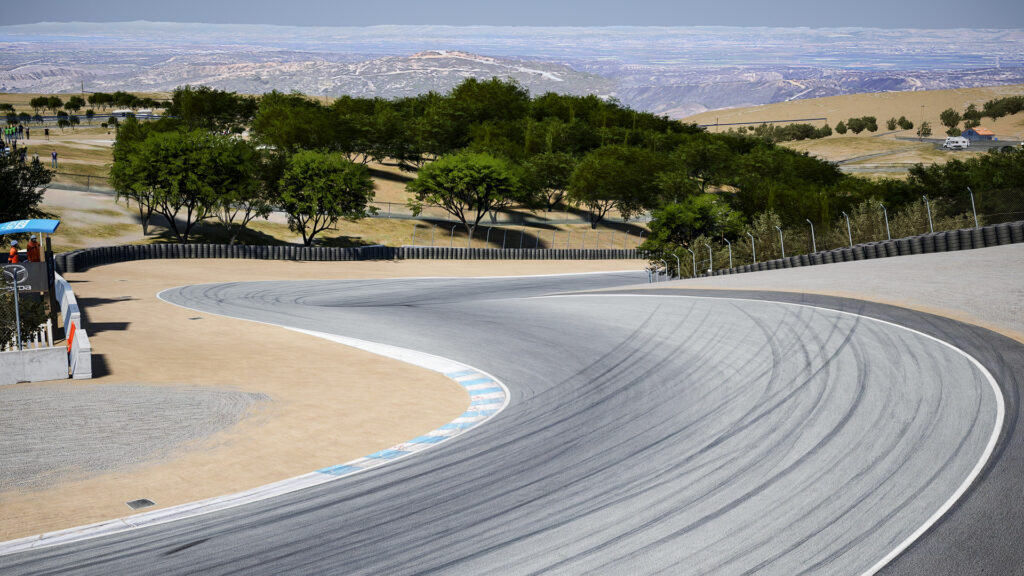
With the MC20, I think it’s capable of doing either a low 1:33 second or a mid 1:32 second lap time. Oh yes, I do indeed think it’ll be faster than the Gen V Viper TA and there are two mains reasons for that. 1: Its 8-speed automatic transmission will undoubtedly help with reducing lost time from gear changes, and 2: It has bigger brakes than the TA.
The MC20 has optional 15.4-inch carbon ceramic rotors with 6-piston monobloc calipers up front and 14.2-inch carbon ceramic rotors with 4-piston monobloc calipers in the rear. Basically the same rotor size that’s on the Gen V ACR with a similar piston count front-to-back. The Gen V TA makes do with just 4-piston calipers and 14-inch rotors all around. When it comes to braking deep and late into a corner, the MC20 will likely have the Gen V Viper beat (much like the late-model C6 ZR1 did nearly a decade ago).
However, the Gen V (and subsequently the Gen VI) have the advantage in tire size. Where the MC20 has just 245-section tires up front and 305-section tires out back, the Gen V has massive 295-section tires up front and gargantuan 355-section tires in the rear. That greater contact patch should lead to better grip even during turn-in. Yes the Viper’s engine is oriented mid-front rather than mid-rear (thus there is still some weight on the nose), however, the snake does have a 50/50 weight distribution. Combine that with the significantly larger front contact patch and the MC20 shouldn’t gain that much –if at all– in this area. If you need further proof of the Viper’s prowess, just look at the Mclaren Senna. That too is mid-engine, has 245-section tires up front, and is only a second faster around Laguna Seca than the Gen V Viper ACR-E. With that in mind, I think my guesses about the MC20 are pretty sound.
The only area the MC20 possibly has a leg up on the Gen V (concerning tires) is modernity. Tire technology has progressed a remarkable amount since the TA set the production lap record at Laguna Seca back in 2014, so even though the MC20 is down on tire size, that could be offset –to whatever degree– by better rubber.
All that said, I do still expect the MC20 to be faster than the Gen V TA, if only by a hair. Its bigger and better brakes, time-saving automatic transmission, stiffer chassis (thanks to its Carbon tub), and anything else I’m forgetting should give it the edge around the famous Californian racetrack.
How The Gen VI Fits Into The Picture

“That’s fascinating and all, but how does any of this relate to the Gen VI Viper?” Here’s how: The MC20, though pretty good (judging from the reviews), is held back by –front– tire size and power. The power isn’t something Maserati can really do much about, seeing as Ferrari only managed slightly more in the 296 GTB with 654 horsepower (ICE-engine only). Unless they go for bigger –possibly slower spooling– turbos or electrification (which they are doing with the Folgore), I don’t think there are many horses left to squeeze out of the Nettuno V6 (at least right now).
And while Maserati could do something about the MC20’s rather “petite” front tire sizes, I’m not sure they will. In writing this article, I looked up other mid-engine cars to see what their front tire widths were. Much to my surprise, most of them also only have 245-section tires in the front. Indeed, few mid-engine supercars use rubber wider than that, the most notable example being the previously mentioned Mclaren Senna. However, there is a recently unveiled supercar that bucks this “thin front tire” trend: The new C8 Corvette Z06, which sports very healthy 275-section tires in the front, so it does happen from time to time.
Regardless, the Gen VI wouldn’t be held back in either of these areas. Even if it had the same front tire widths as the Gen V, that’s still significantly wider rubber than what’s currently offered on the MC20. Not only that, but it would very likely have more power as well. The introduction of the Hellcat V8 and the general progression of supercars has basically guaranteed that such a Viper would need to have more than 700 horsepower.
When it comes to other aspects of the car, things are far less concrete, so forgive me if I engage in a little bit of wish fulfillment for this next part.
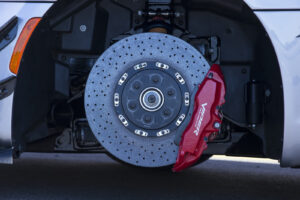
Brakes are –obviously– a very important factor to consider on a high-end performance car like the Viper. The Gen V, both staggeringly and impressively, made do with just 4-piston calipers and 14-inch rotors all the way around. While the 5th iteration of the infamous snake did sterling work on such a setup, there’s no way Dodge could bring this composition back after introducing the herculean ACR brake setup. It’s more than about time Dodge gave the Viper 6-piston calipers up front (and 15-inch steel rotors as standard wouldn’t hurt either). For the rear, 4-piston calipers and 14.2 or 14.4-inch steel rotors should suffice. I say “steel rotors” because those would be standard kit. As an option, you’d be able to get carbon-ceramic rotors (making the Gen VI the first Viper to offer them on even non-ACR models).
For chassis construction, what do you think? All aluminum baby. Among Viper faithfuls, it’s generally believed each Viper was lighter than the last, and that doesn’t change with the Gen VI (in my perfect world). It’d be difficult, but how cool would it be to get this next-gen (though still old-school) Viper down to 3,000 pounds? That’d be a 300-pound weight loss over the Gen V car, and that combined with the additional power means the new car would really rip. Oh, and the chassis would be stiffer as well, ideally to the tune of over 85 percent from the prior car (though 60 to 75 percent would also suffice).

Suspension. Arguably one of the most important aspects of any supercar and the Viper, as you can imagine, is no different. For the Gen VI, I’d like to see a factory version of the Tractive adaptive suspension found on the aftermarket for Gen Vs. If you don’t know what Tractive suspension is, then allow me to explain by doing an impromptu “tech dive”.
On the Gen V GTS, it comes standard with a two-mode Bilstein Damptronic damper. The two modes are street and race, and what they control is the flow rate of the fluid inside the shock. You know how a medical syringe pushes fluid outside the canister by way of a finger-operated “piston”? That’s basically how a shock absorber works (save for the fluid having a way to exit the tube). Now let’s say you fill the syringe with a fluid relatively thick like ketchup (bear with me). If the hole at the end of the syringe is fairly big (relative to the syringe of course) then you should have no problem squeezing the condiment out. However, if the hole is shrunk a fair bit, you’ll have to squeeze a lot harder to get the condiment out of the tube. The two-mode Bilstein damper of the Gen V Viper GTS works in the former way. In street mode, a valve inside the damper (controlled by the Damptronic system) opens to allow the fluid to flow better. This results in the fluid not being bottle-necked as it moves, creating a softer –more comfortable– damping setting thanks to the fluid moving (or dispersing) more freely.
In race mode, however, the damper is much more like that second syringe: Requiring much more pressure –or force– to move the same fluid because the hole has now become a bottleneck. This greater resistance to compression is what makes race mode stiffer –and less comfortable– than street mode.
Now, while the system does allow for some adjustability, it is still a passive system. That means the street mode you experience on a flat, smooth road will have exactly the same damping on a bumpy one. The system doesn’t work to accommodate any change in conditions (thus it being “passive” or “static”), and this is still true even if you go into race mode.

Here is where the Tractive system truly separates itself from the factory setup. While it does still use valves to control the flow rate of the damper fluid, it does work to accommodate changes in driving conditions. That makes this a dynamic or active system, and that’s only half the equation. The other half is the system’s reaction time. The industry average reaction time for active systems like this is between 60 to 100 milliseconds (the latter being 0.1 seconds). This system? Try a super-speed-like six milliseconds. That’s 0.006 seconds, or significantly faster than humans can react reflexively (which is around 80 milliseconds or 0.08 seconds). Where the former system is only about as fast as humanity, the latter Tractive system is pretty much superhuman. What’s more, that’s not just acknowledging a change has been made, but that’s the system acknowledging and making a change to the damping itself! It’s reacting to changes in real-time and adjusting the damping too.
To put it another way: You know that scene in X-Men: Days Of Future Past where Quicksilver rearranges the entire Kitchen? Everyone else is in slow-mo but Quicksilver can both assess the situation and make changes in “real-time” to save Wolverine, Professor X (Charles Xavier), and Magneto. That, in essence, is what the Tractive system can do (though obviously far slower). If that doesn’t give you an idea of how overpowered this system is then I don’t know what will.
Hopefully though, you can see why I’d want such a system in the Gen VI Viper. The system is considered to be a game-changer for Gen Vs, so god only knows how crazy this system would be on a faster, lighter, and better handling Viper.
“All of that is great, but how much faster is this setup over the factory unit? I don’t recall you ever stating anything definitive there…” You’re right, and that’s for one simple reason: I’ve yet to see a definitive head-to-head with the factory and aftermarket units. There are many testimonies about how good the Tractive suspension is, but not many which include a back-to-back lap time comparison. At best, I can give you some anecdotal evidence that should indicate how transformative this suspension is, so let me do that.
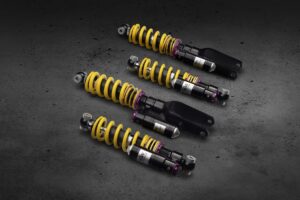
As is often the case with Viper info, what I’m about to tell you comes straight from the Viper Owner’s Association forum. In a thread specifically about the then-new suspension’s release, user FLATOUT talks about some lap times run at MSR Houston between various Vipers (one of which is equipped with the Tractive system). He and another user ran 1:46s and 1:45s on street tires (the tire is not specified), “one of the very best in the area” in a completely prepped Gen IV ACR-X ran a 1:40 on Hoosiers (which I’m assuming means full race slicks), and a one Ben Keating in his own Gen V TA equipped with the Tractive shocks ran a 1:36! What makes that time particularly incredible is that he was on the TA’s standard Pirelli P-Zero Corsas! Make no mistake, the P-Zero Corsa is not a street-legal racing slick either (like the Gen V ACR’s Kumhos). It is sportier than the normal P-Zero, but it’s not street-legal-slick extreme either.
To be that much faster than a non-street legal racecar –the ACR-X– on street tires is nuts! Keep in mind that the ACR-X is lighter, has slightly more torque, has much more downforce than the TA, and was likely running on racing slicks.
In another thread (though I can’t remember which one), another user by the name of Bruce H. said that he got a ride in –another– TA utilizing these shocks and a Gen V ACR running its factory setup. In his post, he said that the TA was (or at least felt) as fast as the ACR. While I don’t know what other mods that TA had done to it, I’m willing to bet it still ran the 4-piston, 14-inch rotor brake setup it comes with as standard.
All of that is to say: I believe this kind of suspension would be a game-changer for a raw, next-gen Viper, as it’s already a game-changer for the Gen V.
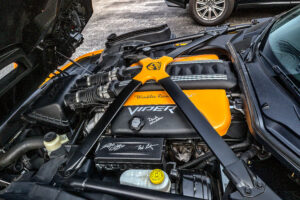
Engine. So far, I’ve been pretty vague about the engine specs I’d like the Gen VI Viper to have, so let me fix that: In my perfect (unrealistic) world, I’d like the Gen VI Viper to have a higher-revving 7.4 or 7.6-liter naturally aspirated V10 that makes north of 750 horsepower. With the C7 ZR1 Corvette making 755 horsepower, there’s no way a new Viper can come out with less than that. However, I’d be fine if this new Viper came out with a tad less than 800 horsepower. Why? Because despite that technically putting it a few ponies down on the Demon, this (and prior) Vipers weigh far less than a Demon, thus meaning the Viper has a far superior power-to-weight ratio. In other words, while the outright output of the Viper would be less, its effective grunt would be far greater. Let’s also not forget there are emissions to consider as well. As for how high I’d like the engine to rev, above 7,000 would be heavenly.
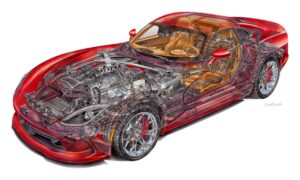
Weight. As with engine specs, I haven’t been all that particular about how much lighter I’d like the Gen VI Viper to be over its predecessor. Truth be told, I’m not totally sure how much more weight can be removed from the Viper platform (old or new). Yes, going to an aluminum construction would definitely save weight, but would that genuinely equate to 100 lbs of savings? I’m not sure. The smaller engine would also help here, but again, how much this would cut weight by is unknown to me.
Ideally, a Gen VI Viper weighing between 3,100 and 3,200 pounds would be amazing (especially 3,100 pounds). All of that power with 100 or 200 pounds cut from the chassis? To use my earlier words: This thing would rip.
“How Fast Do You Think The Gen VI Will Be Then?”

It’s put up or shut up time, right? Very well: Taking everything into consideration, I think the Gen VI Viper should easily put down a 1:30 lap time at Laguna Seca (and yes, that’s on street tires). With the Gen V TA doing a 1:30.7 on racing slicks, and Randy Pobst doing a 1:31.58 at Best Driver’s Car 2016, it’s hard to think a significantly improved Viper wouldn’t be in this realm (especially on the aforementioned dampers). Hell, during a comparison Motor Trend did between the Gen V ACR and the C7 Corvette Z06, the ACR did a 1:30.46. That’s only a few tenths faster than the TA on slicks, and I don’t think I need to reiterate the disadvantages the TA has versus the ACR…
While a Gen V GTS or SRT on slicks was never run, I think either would probably be in the high 1:31 or low 1:32 range (based on how minimally faster the TA was over a “normal” GTS or SRT Viper). To put that into perspective, that would mean a Gen V GTS is roughly as fast as a C7 ZR1, which has 110 more horsepower, more torque, more downforce, and bigger brakes (both in rotor and caliper size). If even a “normal” Viper is that –theoretically– fast with just a tire change, imagine how much of a rocket ship a Gen VI could be.
Thing is, I believe a 1:30 lap time is a modest target at best. With suspension and brakes arguably being the two biggest things holding the Gen V back (as evidenced to some extent by the ACR), a Gen VI with these upgrades and more should easily manage such a lap time. The real goal would be to get a “normal” Gen VI Viper under that 1:30 mark and into the 1:29s or lower if possible. The Mclaren 720S already proved such a feat is possible without going to the same aerodynamic lengths as the 5th gen Viper ACR (clocking in a 1:29.7 at the hands of Randy Pobst), and seeing as that car has become the new benchmark for supercars, it’s only natural to use it as the benchmark for the 6th gen Viper as well (raw or otherwise).
Getting back to the lap time, I think a 1:29 should be achievable if a Gen VI was equipped with carbon-ceramic rotors. The biggest advantage here would be the reduced weight, both outright and in rotational mass. If necessary, combine that with a Track Pack of sorts and the Gen VI should be well on its way to breaking the 1:30 barrier. The icing on top would be if it could surpass or –essentially– match the Gen V ACR-E, but that might be an extremely tall order without some added aero bits or a change in alignment (something that could possibly be covered in the Track Pack).
However, for as great as all that is, it’s not likely to happen.

Tragically though, time is quickly running out to make a “last hurrah” Gen VI Viper like this. With the Hellcats allegedly going the way of the dodo in 2024 thanks to ever-increasing compliance costs, there’s almost no way Dodge would make a new naturally aspirated V10 Viper like this even if they reduced the displacement. If they’re having trouble with a much smaller supercharged V8, then there’s almost no hope for a big naturally aspirated V10. I’m not even sure Porsche’s eFuel or other “syntholine” type fuels will save the V10 either, but that’s an article for another time…
Let’s sum up

To bring this thing full circle again, let’s talk about the MC20. When it comes down to it, more and more sports/supercars are going mid-engine. There are undeniable benefits with this layout and one of the biggest among them is by far and away the faster 0-60 times this layout provides. Chevrolet found this out the hard way when making the C7 ZR1. While they did manage to make the new ZR1 faster than the old ZR1, they had a whale of a time trying to make the new ZR1 faster than that generation’s Z06, and the reason was grip. For the additional hundred horses of the ZR1, it didn’t have an equivalent level of increased traction. Thus, the C7 ZR1 is only 0.1 seconds faster in the 0-60 sprint (2.85 seconds for the ZR1 vs 2.95 seconds for the Z06). Worse still, Chevrolet felt they wouldn’t be able to go any faster with a future ‘Vette using the same FMR setup, and that was obviously a no-go.
Outside of sprint advantages, there’s also the benefit of far less weight on the nose. Yes, the Viper has a 50/50 weight distribution, that doesn’t negate the fact that there is still some weight on the nose though, and that hurts turn-in and overall agility. Having said that, it clearly doesn’t hurt it enough to make sports/supercars using this layout woefully less competitive than their MR counterparts.
All of that is to say: When it comes to bang-for-buck performance, if the MC20 does a 1:30 lap, Dodge might have no choice other than to go with an MR layout –hybridized or not– for their next sports/supercar. Dodge engineers (especially those tasked with the Viper) won’t settle for second place, and if the MC20 manages to do just as much with less, it’s pretty clear what direction Dodge should go next.
However, if the MC20 only does a 1:33 or 1:32 lap time, that leaves a nice amount of breathing room for a good old-fashioned new Viper (Especially if it can dip below 1:30). A two-second lead over the trident-car would be impressive, but three or four seconds would be the kind of domination owners have come to expect from the Viper. That King Of The Hill performance would be back in full-swing, and without sacrificing what makes a Viper a Viper. With increased power, decreased weight, better handling, bigger and better brakes, and better aerodynamics, it certainly looks possible on paper. However, given the current state of the automotive and wider world, such a car looks to be a pipe dream at best…
What do you think though? Do you think a raw Gen VI Viper could compete with the big boys in the current automotive landscape? Let me know in the comments below.